
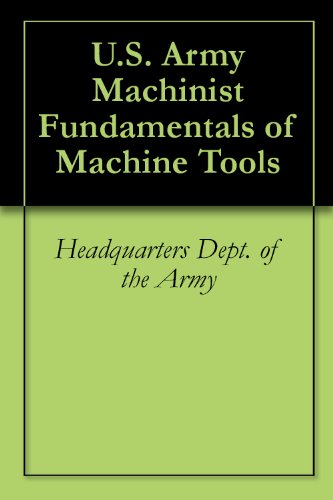
Fundamentals of Machine Tools
Publisher: U. S. Government Printing Office 1996
ISBN/ASIN: B007V539DM
Number of pages: 312
Description:
The purpose of this training circular is to provide a better understanding of power-driven machine tools. It also supplements technical manuals in the 9-3400-series covering power-driven machine tools. One of the main objectives is for this publication is to be clear and understandable. Illustrations throughout this publication show the step-by-step process of many machine shop operations.
Download or read it online for free here:
Download link
(7.1MB, PDF)
Similar books
 Applied Mechanics
by Gaetano Lanza - J. Wiley
The work is a treatise on strength and stability, a number of subjects usually included in treatises on applied mechanics are omitted. It is primarily a text-book, the different subjects are presented in the best way for the progress of the class.
(25261 views)
 Introduction to Continuum Mechanics for Engineers
by Ray M. Bowen - Springer
This textbook is an introduction to the essentials of modern Continuum Mechanics for engineering graduate students. The book is self contained and suitable for self study. It establishes certain classical continuum models within a modern framework.
(19645 views)
 Mechanisms / Machines
by Larry Teel - Delmar Publishers
This material presents the topic of modern machines. It combines the elements of mechanical theory, drafting skills and practical applications. Topics treated: graphical analysis of machines in the areas of velocity and acceleration polygons, etc.
(8607 views)
 Machinery Repairman
by Wayne T. Drew - Naval Education and Training Program
This Training Manual and Nonresident Training Course form a package to teach the theoretical knowledge needed by a Machinery Repairman. This package may be combined with on-the-job training to provide the necessary elements of practical experience.
(8024 views)