
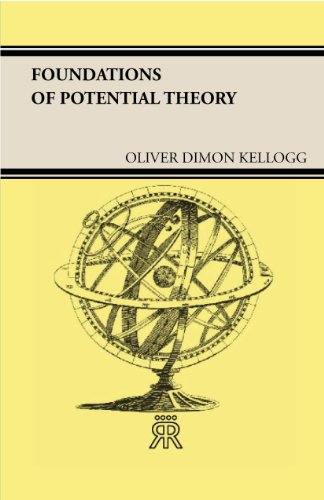
Foundations Of Potential Theory
by Oliver Dimon Kellog
Publisher: Springer 1929
ISBN/ASIN: B004TGIBKC
Number of pages: 406
Description:
The present volume gives a systematic treatment of potential functions. It takes its origin in two courses, one elementary and one advanced, which the author has given at intervals during the last ten years, and has a two-fold purpose: first, to serve as an introduction for students whose attainments in the Calculus include some knowledge of partial derivatives and multiple and line integrals; and secondly, to provide the reader with the fundamentals of the subject, so that he may proceed immediately to the applications, or to the periodical literature of the day.
Download or read it online for free here:
Download link
(multiple formats)
Similar books
 Little Magnetic Book
by Nicolas Raymond - arXiv
'Little Magnetic Book' is devoted to the spectral analysis of the magnetic Laplacian in various geometric situations. In particular the influence of the geometry on the discrete spectrum is analysed in many asymptotic regimes.
(6897 views)
 Physics, Topology, Logic and Computation: A Rosetta Stone
by John C. Baez, Mike Stay - arXiv
There is extensive network of analogies between physics, topology, logic and computation. In this paper we make these analogies precise using the concept of 'closed symmetric monoidal category'. We assume no prior knowledge of category theory.
(10988 views)
 Random Matrix Models and Their Applications
by Pavel Bleher, Alexander Its - Cambridge University Press
The book covers broad areas such as topologic and combinatorial aspects of random matrix theory; scaling limits, universalities and phase transitions in matrix models; universalities for random polynomials; and applications to integrable systems.
(16913 views)
 Group Theory
by Ferdi Aryasetiawan - University of Lund
The text deals with basic Group Theory and its applications. Contents: Abstract Group Theory; Theory of Group Representations; Group Theory in Quantum Mechanics; Lie Groups; Atomic Physics; The Group SU2: Isospin; The Point Groups; The Group SU3.
(16155 views)