
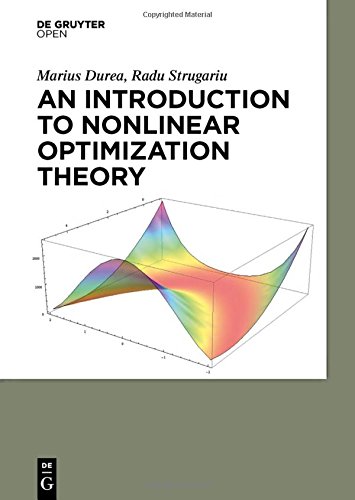
An Introduction to Nonlinear Optimization Theory
by Marius Durea, Radu Strugariu
Publisher: De Gruyter Open 2014
ISBN-13: 9783110426045
Number of pages: 328
Description:
The goal of this book is to present the main ideas and techniques in the field of continuous smooth and nonsmooth optimization. Starting with the case of differentiable data and the classical results on constrained optimization problems, and continuing with the topic of nonsmooth objects involved in optimization theory, the book concentrates on both theoretical and practical aspects of this field.
Download or read it online for free here:
Download link
(multiple PDF files)
Similar books
 The Design of Approximation Algorithms
by D. P. Williamson, D. B. Shmoys - Cambridge University Press
This book shows how to design approximation algorithms: efficient algorithms that find provably near-optimal solutions. It is organized around techniques for designing approximation algorithms, including greedy and local search algorithms.
(15908 views)
 Linear Programming
by Jim Burke - University of Washington
These are notes for an introductory course in linear programming. The four basic components of the course are modeling, solution methodology, duality theory, and sensitivity analysis. We focus on the simplex algorithm due to George Dantzig.
(7997 views)
 Convex Optimization: Algorithms and Complexity
by Sebastien Bubeck - arXiv.org
This text presents the main complexity theorems in convex optimization and their algorithms. Starting from the fundamental theory of black-box optimization, the material progresses towards recent advances in structural and stochastic optimization.
(6245 views)
 Linear Complementarity, Linear and Nonlinear Programming
by Katta G. Murty
This book provides an in-depth and clear treatment of all the important practical, technical, computational, geometric, and mathematical aspects of the Linear Complementarity Problem, Quadratic Programming, and their various applications.
(11514 views)