
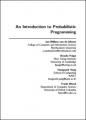
An Introduction to Probabilistic Programming
by Jan-Willem van de Meent, et al.
Publisher: arXiv.org 2018
Number of pages: 218
Description:
This document is designed to be a first-year graduate-level introduction to probabilistic programming. It not only provides a thorough background for anyone wishing to use a probabilistic programming system, but also introduces the techniques needed to design and build these systems. It is aimed at people who have an undergraduate-level understanding of either or, ideally, both probabilistic machine learning and programming languages.
Download or read it online for free here:
Download link
(3.4MB, PDF)
Similar books
 Understanding Machine Learning: From Theory to Algorithms
by Shai Shalev-Shwartz, Shai Ben-David - Cambridge University Press
This book introduces machine learning and the algorithmic paradigms it offers. It provides a theoretical account of the fundamentals underlying machine learning and mathematical derivations that transform these principles into practical algorithms.
(10122 views)
 Gaussian Processes for Machine Learning
by Carl E. Rasmussen, Christopher K. I. Williams - The MIT Press
Gaussian processes provide a principled, practical, probabilistic approach to learning in kernel machines. The treatment is comprehensive and self-contained, targeted at researchers and students in machine learning and applied statistics.
(27651 views)
 The LION Way: Machine Learning plus Intelligent Optimization
by Roberto Battiti, Mauro Brunato - Lionsolver, Inc.
Learning and Intelligent Optimization (LION) is the combination of learning from data and optimization applied to solve complex problems. This book is about increasing the automation level and connecting data directly to decisions and actions.
(35489 views)
 Algorithms for Reinforcement Learning
by Csaba Szepesvari - Morgan and Claypool Publishers
We focus on those algorithms of reinforcement learning that build on the theory of dynamic programming. We give a comprehensive catalog of learning problems, describe the core ideas, followed by the discussion of their properties and limitations.
(7736 views)