
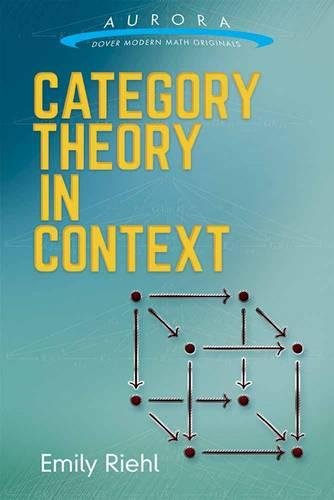
Category Theory in Context
by Emily Riehl
Publisher: Dover Publications 2016
Number of pages: 258
Description:
This concise, original text for a one-semester introduction to the subject is derived from courses that author Emily Riehl taught at Harvard and Johns Hopkins Universities. The treatment introduces the essential concepts of category theory: categories, functors, natural transformations, the Yoneda lemma, limits and colimits, adjunctions, monads, Kan extensions, and other topics.
Download or read it online for free here:
Download link
(1.3MB, PDF)
Similar books
 Dynamical Systems and Sheaves
by D. I. Spivak, C. Vasilakopoulou, P. Schultz - arXiv
A categorical framework for modeling and analyzing systems in a broad sense is proposed. These systems should be thought of as 'machines' with inputs and outputs, carrying some sort of signal that occurs through some notion of time.
(7155 views)
 Categories and Homological Algebra
by Pierre Schapira - UPMC
These notes introduce the language of categories and present the basic notions of homological algebra, first from an elementary point of view, next with a more sophisticated approach, with the introduction of triangulated and derived categories.
(10366 views)
 Category Theory for Programmers
by Bartosz Milewski - unglue.it
Category theory is the kind of math that is particularly well suited for the minds of programmers. It deals with the kind of structure that makes programs composable. And I will argue strongly that composition is the essence of programming.
(7362 views)
 Category Theory for Scientists
by David I. Spivak - arXiv
We attempt to show that category theory can be applied throughout the sciences as a framework for modeling phenomena and communicating results. In order to target the scientific audience, this book is example-based rather than proof-based.
(10396 views)