
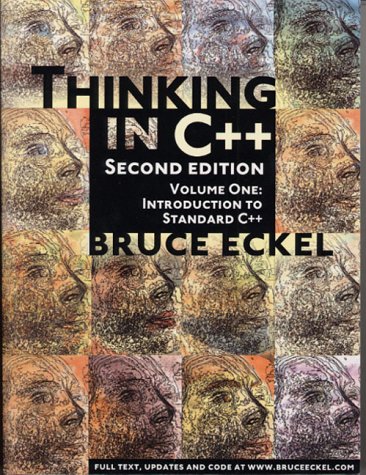
Thinking in C++, 2nd Edition
by Bruce Eckel
Publisher: Prentice Hall 2003
ISBN/ASIN: 0139798099
ISBN-13: 9780139798092
Number of pages: 1600
Description:
The new edition of Bruce Eckel's Thinking in C++ is an excellent tutorial to mastering this rich (and sometimes daunting) programming language, filled with expert advice and written in a patient, knowledgeable style. The emphasis here is on practical programming, so there's basic advice on using header files, preprocessor directives, and namespaces to organize code effectively.
Download or read it online for free here:
Download link 1
Download link 2
(multiple PDF files)
Similar books
 An Introduction to Design Patterns in C++ with Qt 4
by Alan Ezust, Paul Ezust - Prentice Hall PTR
Covers the language features of C++ so that readers can use Qt 4 classes in the examples and assignments. It is a textbook for teaching language and design patterns, emphasising open-source code reuse. It assumes no C++ programming experience.
(17111 views)
 A Computer Science Tapestry: Exploring Computer Science with C++
by Owen L. Astrachan - McGraw - Hill
This book is designed for a first course in computer science that uses C++ as the programming language. The goal was to leverage the best features of the language using sound practices of programming and pedagogy in the study of computer science.
(20262 views)
 An Introduction to the Imperative Part of C++
by Rob Miller - Imperial College London
These lecture notes are designed for an introductory course on programming, using the imperative core of C++. Very little previous programming experience is assumed. All the example programs have been written in ANSI standard C++.
(18474 views)
 Mastering C++
by K. R. Venugopal - Muhammadali Shaduli
The book covers concepts such as programming paradigms, the need for OOPs technology, extending C/C++ at a glance, fundamental constructs of the C++ language, classes and objects, inheritance, polymorphism, generic programming, streams computations.
(18615 views)