
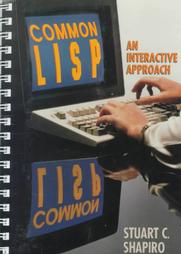
Common Lisp: An Interactive Approach
by Stuart Charles Shapiro
Publisher: W.H. Freeman & Company 1999
ISBN/ASIN: 0716782189
ISBN-13: 9780716782186
Number of pages: 358
Description:
The purpose of this book is to teach the Common Lisp programming language. Because of the varied interests in Lisp, this book has tried to present it in a general and neutral setting, rather than specifically in the context of any of the special fields in which it is used. Since this book assumes that students will have had experience with some imperative programming language, it teaches pure Lisp before the imperative constructs.
Download or read it online for free here:
Download link
(multiple formats)
Similar books
 Design of CMU Common Lisp
by Robert A. MacLachlan
This text documents internal details of the CMU Common Lisp compiler and run-time system. CMU Common Lisp is a public domain implementation of Common Lisp that runs on Unix workstations. It provides some useful information on the CMUCL compiler.
(18482 views)
 Let Over Lambda: 50 Years of Lisp
by Doug Hoyte - Lulu.com
One of the most hardcore computer programming books out there. Starting with the fundamentals, it describes the most advanced features of the most advanced language: Common Lisp. This book is about macros, that is programs that write programs.
(22370 views)
 LISP 1.5 Primer
by Clark Weissman - Dickenson Publishing Company
The chapters of this book expose the reader to the LISP formalism and give him an opportunity to acquire the necessary skills for processing symbolic data. Learning these skills is analogous to learning the rules of arithmetic ...
(6813 views)
 Common Lisp
- Wikibooks
Common Lisp is a modern, multi-paradigm, high-performance, ANSI-standardized programming language. Contents: First steps; Basic topics; Advanced topics; Beyond ANSI Common Lisp; External libraries; Implementation Issues; Case Studies in CL; etc.
(14722 views)