
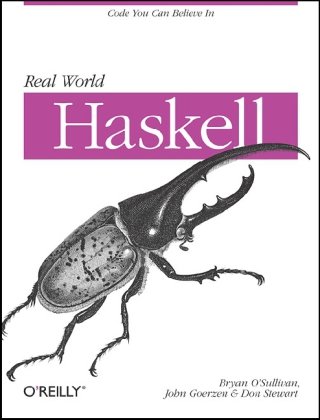
Real World Haskell
by B. O'Sullivan, J. Goerzen, D. Stewart
Publisher: O'Reilly Media, Inc. 2008
ISBN/ASIN: 0596514980
ISBN-13: 9780596514983
Number of pages: 710
Description:
Real World Haskell takes you through the basics of functional programming at a brisk pace, and then helps you increase your understanding of Haskell in real-world issues like I/O, performance, dealing with data, concurrency, and more as you move through each chapter. With this book, you will: Understand the differences between procedural and functional programming; Learn the features of Haskell, and how to use it to develop useful programs; Interact with filesystems, databases, and network services; Write solid code with automated tests, code coverage, and error handling; Harness the power of multicore systems via concurrent and parallel programming.
Download or read it online for free here:
Read online
(online html)
Similar books
 Haskell Tutorial for C Programmers
by Eric Etheridge - HaskellWiki
Haskell has both more flexibility and more control than most languages. For computer science students, Haskell is weird and obtuse. This online tutorial assumes that the reader is familiar with C/C++, Python, Java, or Pascal.
(14809 views)
 The Haskell Road to Logic, Maths and Programming
by Kees Doets, Jan van Eijck - College Publications
The purpose of this book is to teach logic and mathematical reasoning in practice, and to connect logical reasoning with computer programming. The programming language that will be our tool for this is Haskell, a member of the Lisp family.
(19854 views)
 Beautiful Code, Compelling Evidence
by J.R. Heard - Renaissance Computing Institute
The book discusses why functional programming, and more specifically Haskell, is good for graphics and also runs through some of the basic tools that exist. Written for a programmer interested in visualization and functional programming.
(6302 views)
 Learn Haskell Fast and Hard
by Yann Esposito - yannesposito.com
A very short and dense tutorial for learning Haskell. This text will certainly be hard to follow. This is on purpose. There is no shortcut to learning Haskell. It is hard and challenging. It is because it is hard that Haskell is interesting.
(7744 views)