
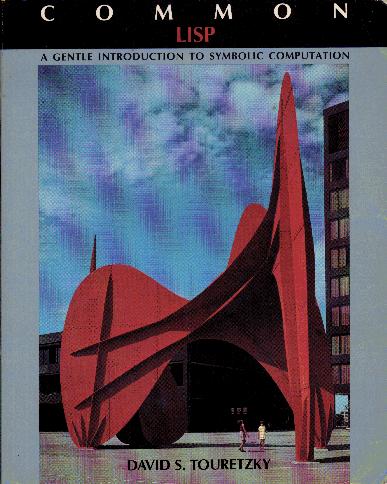
Common LISP: A Gentle Introduction to Symbolic Computation
by David S. Touretzky
Publisher: Benjamin-Cummings Pub Co 1990
ISBN/ASIN: 0805304924
ISBN-13: 9780805304923
Number of pages: 587
Description:
This book is about learning to program in Lisp. Although widely known as the principal language of artificial intelligence research—one of the most advanced areas of computer science—Lisp is an excellent language for beginners. It is increasingly the language of choice in introductory programming courses due to its friendly, interactive environment, rich data structures, and powerful software tools that even a novice can master in short order.
Download or read it online for free here:
Download link
(1.1MB, PDF)
Similar books
 Introduction to Computer Science using Java
by Bradley Kjell - Central Connecticut State University
The text for a first course in computer science using the programming language Java. It covers the fundamentals of programming and of computer science. It is assumed that you have the Java version 5.0 or later and a text editor such as Notepad.
(27410 views)
 How to think like a Computer Scientist (C++ Version)
by Allen B. Downey
This book teaches you to think like a computer scientist - to combine the best features of mathematics, natural science, and engineering, to use formal languages to denote ideas, to observe the behavior of complex systems, form hypotheses, etc.
(25047 views)
 Introduction to Soft Computing
by Eva Volna - Bookboon
This book gives an introduction to Soft Computing, which aims to exploit tolerance for imprecision, uncertainty, approximate reasoning, and partial truth in order to achieve close resemblance with human like decision making.
(9306 views)
 Mathematical Foundations of Computer Science
by Susan Rodger - Duke University
These lecture notes present an introduction to theoretical computer science including studies of abstract machines, the language hierarchy from regular languages to recursively enumerable languages, noncomputability and complexity theory.
(16517 views)