
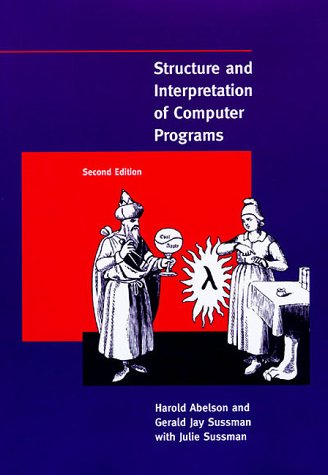
Structure and Interpretation of Computer Programs
by Harold Abelson, Gerald Jay Sussman, Julie Sussman
Publisher: McGraw-Hill 1996
ISBN/ASIN: 0262011530
ISBN-13: 9780262011532
Number of pages: 588
Description:
Abelson and Sussman's classic Structure and Interpretation of Computer Programs teaches readers how to program by employing the tools of abstraction and modularity. The authors' central philosophy is that programming is the task of breaking large problems into small ones. The book spends a great deal of time considering both this decomposition and the process of knitting the smaller pieces back together.
Download or read it online for free here:
Read online
(online html)
Similar books
 Comparative Studies of Programming Languages
by Joey Paquet, Serguei A. Mokhov - arXiv
Lecture notes for the Comparative Studies of Programming Languages course. These notes include a compiled book of primarily related articles from the Wikipedia, as well as Comparative Programming Languages book and other resources.
(10046 views)
 Type Systems for Programming Languages
by Robert Harper
Provides an account of the role of type theory in programming language design and implementation. The stress is on the use of types as a tool for analyzing programming language features and studying their implementation.
(16386 views)
 Compositional Semantics
by Gary Hardegree - UMass Amherst
Contents: Basic Categorial Syntax; Shortcomings of Standard Categorial Syntax; Expanded Categorial Syntax; Examples of Expanded Categorial Syntax; Categorial Logic; Basic Categorial Semantics; Lambda-Abstraction; Expanded Categorial Semantics; etc.
(15889 views)
 Understanding Programming Languages
by Monti Ben-Ari - John Wiley & Sons
The book explains what alternatives are available to the language designer, how language constructs should be used for safety and readability, how language constructs are implemented, the role of language in expressing and enforcing abstractions.
(16929 views)