
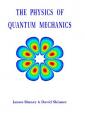
The Physics of Quantum Mechanics
by James Binney, David Skinner
Publisher: Capella Archive 2008
ISBN/ASIN: 1902918487
ISBN-13: 9781902918488
Number of pages: 278
Description:
This book aims to give students the best possible understanding of the physical implications of quantum mechanics by explaining how quantum systems evolve in time, and showing the close parallels between quantum and classical dynamics. The mathematical development of the subject is more self-contained and rigorous than in traditional texts because most eigenvalue problems are solved by operator methods.
Download or read it online for free here:
Download link
(2.9MB, PDF)
Similar books
 Quantum Notes
by Jed Rembold - New Mexico Tech
The complete set of graduate Quantum Mechanics notes: Postulates of QM; Simple Problems in 1 Dimension; Wave Packets; Harmonic Oscillator and Second Quantization; Systems with N Degrees of Freedom; Classical Limit and WKB Approximation; Symmetries.
(13099 views)
 Quantum mechanics of many-particle systems: atoms, molecules - and more
by Roy McWeeny - Learning Development Institute
Quantum mechanics of many-particle systems. Contents: The problem - and how to deal with it; Some two-electron systems; Electronic structure - the independent particle model; The Hartree-Fock method; Atoms - the building blocks of matter.
(9729 views)
 Quantum Walks
by Daniel Reitzner, Daniel Nagaj, Vladimir Buzek - arXiv
This text showcases the many varieties and uses of quantum walks. Discrete time quantum walks are introduced as counterparts of classical random walks. The emphasis is on the connections and differences between the two types of processes ...
(8701 views)
 Relativistic Quantum Dynamics
by Eugene V. Stefanovich
A non-traditional perspective on space, time, particles, fields, and action-at-a-distance. This book is an attempt to build a consistent relativistic quantum theory of interacting particles. The developed theory is applied to realistic physical objects.
(16367 views)