
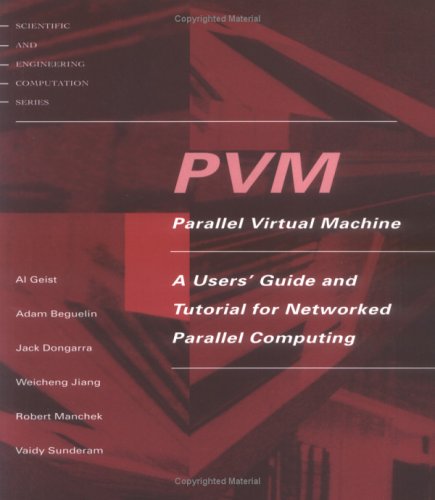
PVM: Parallel Virtual Machine
by Al Geist, at al.
Publisher: The MIT Press 1994
ISBN/ASIN: 0262571080
ISBN-13: 9780262571081
Number of pages: 299
Description:
Written by the team that developed the software, this tutorial is the definitive resource for scientists, engineers, and other computer users who want to use PVM to increase the flexibility and power of their high-performance computing resources. PVM introduces distributed computing, discusses where and how to get the PVM software, provides an overview of PVM and a tutorial on setting up and running existing programs, and introduces basic programming techniques including putting PVM in existing code.
Download or read it online for free here:
Read online
(online html)
Similar books
 Distributed Detection and Estimation in Wireless Sensor Networks
by Sergio Barbarossa, Stefania Sardellitti, Paolo Di Lorenzo - arXiv
We consider the problems of distributed detection and estimation in wireless sensor networks. We provide a general framework aimed to show how an efficient design of a sensor network requires a joint organization of in-network communication.
(7728 views)
 BIG CPU, BIG DATA: Solving the World's Toughest Problems with Parallel Computing
by Alan Kaminsky - Rochester Institute of Technology
With the book BIG CPU, BIG DATA, my goal is to teach you how to write parallel programs that take full advantage of the vast processing power of modern multicore computers, compute clusters, and graphics processing unit (GPU) accelerators.
(7061 views)
 Introduction to Distributed Systems
by Sabu M. Thampi - arXiv
An overview of distributed computing systems. The definition, architecture, characteristics of distributed systems and the various fallacies are discussed. Finally, discusses client/server computing, World Wide Web and types of distributed systems.
(9453 views)
 The Practice of Parallel Programming
by Sergey A. Babkin - CreateSpace
This book provides an advanced guide to the issues of the parallel and multithreaded programming. It goes beyond the high-level design of the applications, into the details that are often overlooked but vital to make the programs work.
(21027 views)