
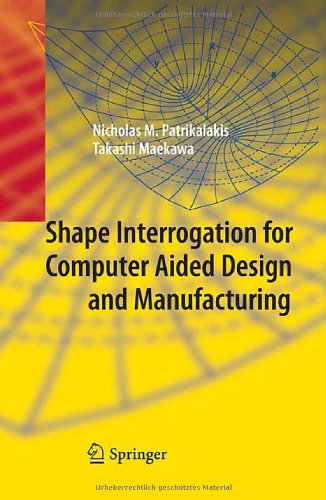
Shape Interrogation for Computer Aided Design and Manufacturing
by Nicholas M. Patrikalakis, Takashi Maekawa
Publisher: Springer 2009
ISBN/ASIN: 364204073X
ISBN-13: 9783642040733
Number of pages: 408
Description:
Shape interrogation is the process of extraction of information from a geometric model. It is a fundamental component of Computer Aided Design and Manufacturing (CAD/CAM) systems. The authors focus on shape interrogation of geometric models bounded by free-form surfaces. Free-form surfaces, also called sculptured surfaces, are widely used in the bodies of ships, automobiles and aircraft, which have both functionality and attractive shape requirements.
Download or read it online for free here:
Read online
(online html)
Similar books
 Modelling and Simulation
by Giuseppe Petrone, Giuliano Cammarata - InTech
This book collects research studies concerning modeling and simulation of physical systems in a very wide range of applications: micro-electro-mechanical systems, measurement instrumentations, catalytic reactors, biomechanical applications, etc.
(15798 views)
 Computer Simulation Techniques - The Definitive Introduction
by Harry Perros - NC State University
The generation of pseudo-random numbers, the generation of stochastic variates, simulation designs, estimation techniques for analyzing endogenously created data, validation of a simulation model, variance reduction techniques, etc.
(16550 views)
 Modeling, Simulation and Optimization: Tolerance and Optimal Control
by Shkelzen Cakaj - InTech
Topics covered: parametric representation of shapes, modeling of dynamic continuous fluid flow process, plant layout optimal plot plan, atmospheric modeling, cellular automata simulations, thyristor switching characteristics simulation, etc.
(16598 views)
 Dynamic Modelling
by Alisson V. Brito - InTech
Dynamic modelling means modelling processes or systems, which are formed by attributes changing over time. Vehicles transmission and engines, reconfigurable microchips, earthquakes and the effect of diseases in organisms are presented in this book.
(13580 views)