
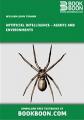
Artificial Intelligence - Agents and Environments
by William John Teahan
Publisher: BookBoon 2010
ISBN-13: 9788776815288
Number of pages: 154
Description:
This book is the first in a series on Artificial Intelligence. It provides an introduction to the topic with an emphasis on the use of agent-oriented design. Topics include agents, environments, agent movement, and agent embodiment. It also provides an introduction to programming in NetLogo.
Download or read it online for free here:
Download link
(8.6MB, PDF)
Similar books
 The Quest for Artificial Intelligence
by Nils J. Nilsson - Cambridge University Press
Artificial intelligence is a field within computer science that is attempting to build enhanced intelligence into computer systems. This book traces the history of the subject, from the eighteenth-century pioneers to the work of today-s AI engineers.
(16324 views)
 Ambient Intelligence
by Felix Jesus Villanueva Molina - InTech
In this book we analyze a selection of open problems which we consider the key ones in order to let ambient intelligence become a reality. This book provides the reader with a good idea about the current research lines in ambient intelligence.
(14423 views)
 Bayesian Network
by Ahmed Rebai (ed.) - InTech
Bayesian networks are a general tool that can be used for a large number of problems involving uncertainty: reasoning, learning, planning and perception. This is a collection of contributions to the methodology and applications of Bayesian networks.
(7616 views)
 The World and Mind of Computation and Complexity
by Gregg Schaffter
With the increase in development of technology, there is research of human-like artificial intelligence that can be self-aware and act just like humans. This book explores how we may be close to developing a true artificially intelligent being.
(9684 views)