
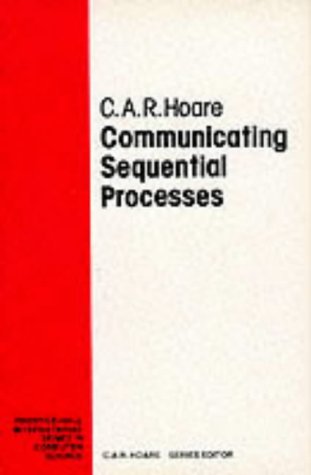
Communicating Sequential Processes
by C.A.R. Hoare
Publisher: Prentice Hall 2004
ISBN/ASIN: 0131532715
ISBN-13: 9780131532717
Number of pages: 260
Description:
Communicating Sequential Processes, or CSP, is a language for describing patterns of interaction. It is supported by an elegant, mathematical theory, a set of proof tools, and an extensive literature. The book Communicating Sequential Processes is an excellent introduction to the language, and also to the mathematical theory.
Download or read it online for free here:
Download link
(1.2MB, PDF)
Similar books
 The New Software Engineering
by Sue Conger - Global Text Project
The book discusses software engineer's project related knowledge and theoretical background. It covers project planning, project life cycles, methodologies, technologies, techniques, tools, languages, testing, databases, and CASE.
(19379 views)
 Software Architecture
by A. Bijlsma, B.J. Heeren, E.E. Roubtsova, S. Stuurman - FTA
The central theme of this book is balancing the concerns and requirements of stakeholders, combining these into an architecture proposal by employing known tactics and patterns, producing a description of the architecture that can be communicated.
(14082 views)
 Knowware: the third star after Hardware and Software
by Ruqian Lu - Polimetrica
This book proposes to separate knowledge from software and to make it a commodity that is called knowware. The architecture, representation and function of Knowware are discussed. The principles of knowware engineering are analyzed.
(12024 views)
 The Guide to the Software Engineering Body of Knowledge
by P. Bourque, R. Dupuis, A. Abran, J. W. Moore, and L. L. Tripp - IEEE
The purpose of this guide is to provide a consensually validated characterization of the bounds of the software engineering discipline and to provide a topical access to the Body of Knowledge supporting that discipline.
(18743 views)