
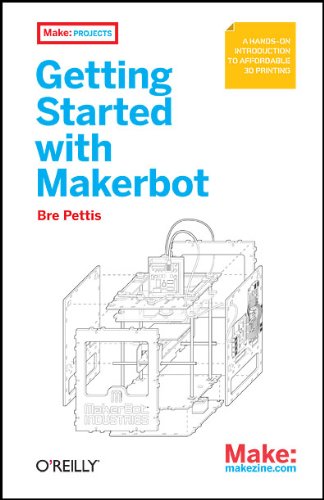
Getting Started with MakerBot
by Bre Pettis, Jay Shergill
Publisher: O'Reilly Media 2011
ISBN/ASIN: 1449399061
ISBN-13: 9781449399061
Description:
Get a hands-on introduction to the world of personal fabrication with the MakerBot, the easiest and most affordable rapid prototyper available. This book shows you how the MakerBot open source 3D printer democratizes manufacturing and brings the power of large factories right to your desktop.
Download or read it online for free here:
Read online
(online preview)
Similar books
 Image Processing in C: Analyzing and Enhancing Digital Images
by Dwayne Philipps - R & D Books
An image processing tutorial which explains basic concepts, shows results with photographs, and implements programs in C. The book covers filters, edge detectors, and histogram equalizers, print procedures, and I/O routines, which are ready to use.
(27157 views)
 Digital Image Processing
by Huiyu Zhou, Jiahua Wu, Jianguo Zhang - BookBoon
This book introduces the fundamental theories of modern digital image processing including intensity transformations, filtering in the frequency and spatial domain, restoration, colour processing, morphological operations, and segmentation.
(17787 views)
 Fundamentals of Image Processing
by I. Young, J. Gerbrands, L. van Vliet - Delft University of Technology
The book focuses on the fundamental concepts of image processing. We will restrict ourselves to 2D image processing although most of the concepts and techniques that are to be described can be extended easily to three or more dimensions.
(14745 views)
 Effective Video Coding for Multimedia Applications
by Sudhakar Radhakrishnan - InTech
The book revolves around three different challenges namely (i) Coding strategies (coding efficiency and computational complexity), (ii) Video compression and (iii) Error resilience. The complete efficient video system depends upon source coding.
(9142 views)