
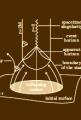
Recent Developments in Gravitational Collapse and Spacetime Singularities
by Pankaj S. Joshi, Daniele Malafarina
Publisher: arXiv 2012
Number of pages: 89
Description:
It is now known that when a massive star collapses under the force of its own gravity, the final fate of such a continual gravitational collapse will be either a black hole or a naked singularity under a wide variety of physically reasonable circumstances within the framework of general theory of relativity. The research of recent years has provided considerable clarity and insight on stellar collapse, black holes and the nature and structure of spacetime singularities. We discuss several of these developments here.
Download or read it online for free here:
Download link
(990KB, PDF)
Similar books
 Lecture Notes on High Energy Cosmic Rays
by M. Kachelriess - arXiv.org
A concise introduction into high energy cosmic ray physics, including also few related aspects of high energy gamma-ray and neutrino astrophysics. The emphasis is placed on astrophysical questions, and the level of the presentation is kept basic.
(5871 views)
 Primordial Nucleosynthesis: from precision cosmology to fundamental physics
by F. Iocco, G. Mangano, G. Miele, O. Pisanti, P.D. Serpico - arXiv
We present an up-to-date review of Big Bang Nucleosynthesis. We discuss the improvements which have been achieved in the past decades on the overall theoretical framework, summarize the impact of new experimental results on nuclear reaction rates.
(10634 views)
 Astronuclear Physics: a Tale of the Atomic Nuclei in the Skies
by M. Arnould, S. Goriely - arXiv.org
A century ago, nuclear physics entered astrophysics, giving birth to a new field of science. The present Astronuclear Physics review focuses primarily on the facets of nuclear physics that are of relevance to astronomy and astrophysics.
(3238 views)
 Supernova Remnants: The X-ray Perspective
by Jacco Vink - arXiv
Supernova remnants are beautiful astronomical objects that are also of high scientific interest, because they provide insights into supernova explosion mechanisms, and because they are the likely sources of Galactic cosmic rays.
(10744 views)