
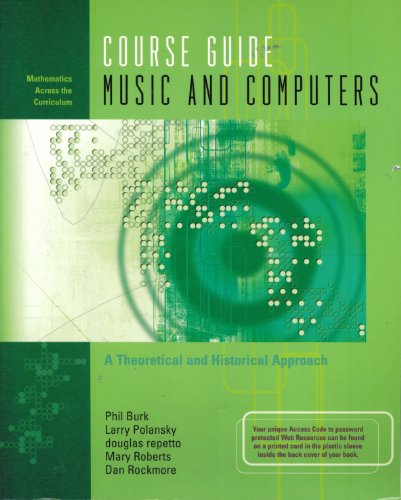
Music and Computers
by Phil Burk, et al.
Publisher: Columbia University 2011
ISBN/ASIN: 1930190956
Number of pages: 188
Description:
This book is intended as a user-friendly introduction to music and computers for college and upper-division secondary students. By organizing a presentation around interactive visual and sonic examples, we hope to provide a resource and guide for those just beginning to look at the field of computer music, as well as for more advanced computer composers who might benefit from a fresh insight.
Download or read it online for free here:
Read online
(online reading)
Similar books
 Loadbang: Programming Electronic Music in Pure Data
by Johannes Kreidler - Wolke Verlagsges. Mbh
The book is designed for self-study, principally for composers. It begins with explanations of basic programming and acoustic principles then gradually builds up to the most advanced electronic music processing techniques.
(10749 views)
 Physical Audio Signal Processing
by Julius O. Smith III - DSPRelated.com
This book was developed for a course entitled 'Signal Processing Methods in Musical Acoustics'. The text was created primarily as a research preparation and dissemination vehicle intended for graduate students in computer music and engineering.
(17541 views)
 Sonifying Processing: The Beads Tutorial
by Evan X. Merz
The book introduces audio programming to Processing programmers through the Beads library. It covers topics such as synthesis, sampling and general sound-mangling in such a way that is appropriate for beginners, or more experienced programmers.
(9307 views)
 Audio Signal Processing
by Vesa Valimaki - MDPI AG
Audio signal processing is a highly active research field where digital signal processing theory meets human sound perception and real-time programming requirements. It has a wide range of applications in computers, gaming, music technology, etc.
(7189 views)