
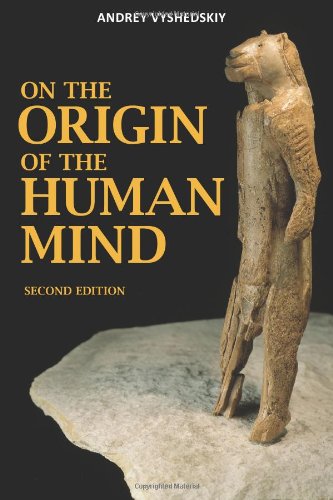
On the Origin of the Human Mind
by Andrey Vyshedskiy
Publisher: MobileReference 2014
ISBN/ASIN: 1492963615
Number of pages: 442
Description:
The origin of the human mind remains one of the greatest mysteries of all times. Using his background in neuroscience, the author offers an elegant, parsimonious theory of the evolution of the human mind and suggests experiments that could be done to test, refute, or validate the hypothesis.
Download or read it online for free here:
Download link
(12MB, PDF)
Similar books
 Encyclopedia of Computational Neuroscience
by Eugene M. Izhikevich, at al. - Scholarpedia
Neuroscience, Electrophysiology, Neuron, Network Dynamics, Brain Models, Synapse, Memory, Conditioning, Consciousness, Vision, Olfaction, Neuroimaging, Dynamical Systems, Oscillators, Synchronization, Pattern Formation, Chaos, Bifurcations, etc.
(16397 views)
 Dynamics of Cyclic Nucleotide Signaling in Neurons
by Nicholas C Spitzer, Pierre Vincent (eds) - Frontiers Media SA
Cyclic nucleotides control a number of neuronal properties including neuronal differentiation, pathfinding, regulation of excitability and synaptic transmission, and control of gene expression. Signaling events mediated by cAMP or cGMP are transient.
(7374 views)
 The Neurobiology of Olfaction
by Anna Menini - CRC Press
The book provides a thorough analysis of the state-of-the-science in olfactory knowledge. Authors explore various aspects of olfaction, including genetics, behavior, olfactory systems, odorant receptors, odor coding, and cortical activity.
(10185 views)
 Developing Synaesthesia
by Nicolas Rothen, Julia Simner, Beat Meier - Frontiers Media SA
Synaesthesia is a condition in which a stimulus elicits an additional subjective experience. The aim of this book on synaesthesia is to provide novel insights into the development of synaesthesia both in its genuine and acquired form.
(7146 views)