
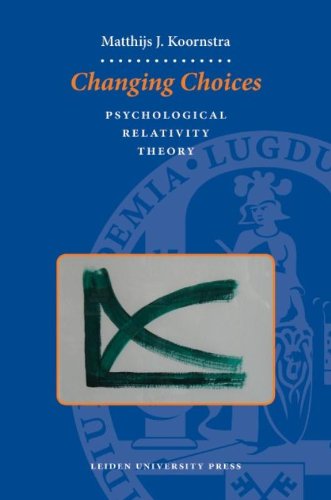
Changing Choices: Psychological Relativity Theory
by Matthijs J. Koornstra
Publisher: Leiden University Press 2007
ISBN/ASIN: 9087280181
ISBN-13: 9789087280185
Number of pages: 514
Description:
The book contains a unifying theory on how the common object space is metrically transformed by individuals with different transformation parameters, due to their other previous experiences, to individually different psychological spaces for judgment on the one hand and preference on the other hand. Individual experiences also change generally, whereby the psychological spaces also change generally for each individual.
Download or read it online for free here:
Download link
(7.4MB, PDF)
Similar books
 From Complexity to Creativity
by Ben Goertzel - Plenum Press
This text applies the concepts of complexity science to provide an explanation of all aspects of human creativity. The book describes the model that integrates ideas from computer science, mathematics, neurobiology, philosophy, and psychology.
(15746 views)
 Human Nature and Conduct
by John Dewey - Henry Holt & Co.
Influential work by the great educator/philosopher maintains that the key to social psychology lies in an understanding of the many varieties of habit; individual mental activity is guided by subordinate factors of impulse and intelligence.
(8808 views)
 Psychology: A Study Of Mental Life
by Robert S. Woodworth - Henry Holt and company
Modern psychology is an attempt to bring the methods of scientific investigation, which have proved immensely fruitful in other fields, to bear upon mental life and its problems. Originally published in 1921, the book is intended for the beginner.
(14698 views)
 Applied History of Psychology
- Wikibooks
This book represents a history of psychology -- not the only one and certainly not a complete one, but definitely an interesting one and one that represents many of the varied interests of the students in this particular class.
(13258 views)