
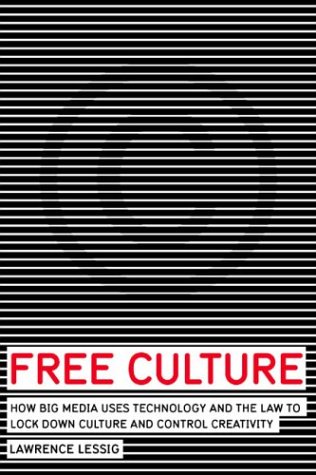
Free Culture
by Lawrence Lessig
Publisher: Penguin Press HC 2004
ISBN/ASIN: 1594200068
ISBN-13: 9781594200069
Number of pages: 352
Description:
"How Big Media Uses Technology and the Law to Lock Down Culture and Control Creativity". Lawrence Lessig shows us that while new technologies always lead to new laws, never before have the big cultural monopolists used the fear created by new technologies, specifically the Internet, to shrink the public domain of ideas, even as the same corporations use the same technologies to control more and more what we can and can't do with culture. As more and more culture becomes digitized, more and more becomes controllable, even as laws are being toughened at the behest of the big media groups. What's at stake is our freedom-freedom to create, freedom to build, and ultimately, freedom to imagine.
Download or read it online for free here:
Download link
(2.5MB, PDF)
Similar books
 Digital Copyright
by Jessica Litman - Michigan Publishing Services
Jessica Litman questions whether copyright laws crafted by lawyers and their lobbyists really make sense for the vast majority of us. Should every interaction between ordinary consumers and copyright-protected works be restricted by law?
(6854 views)
 A Philosophy of Intellectual Property
by Peter Drahos - ANU eText
The author argues that lying at the heart of intellectual property are duty-bearing privileges. The book is designed to be accessible to specialists in a number of fields. It will interest philosophers, political scientists, and legal scholars.
(7106 views)
 Intellectual Property Strategy
by John Palfrey - The MIT Press
How a flexible and creative approach to intellectual property can help an organization accomplish goals. John Palfrey offers a short briefing on intellectual property strategy for corporate managers and nonprofit administrators.
(5382 views)
 What if we could reimagine copyright?
by Rebecca Giblin, Kimberlee Weatherall - ANU Press
The leading international thinkers represented in this collection reconsider copyright's fundamental questions: the subject matter that should be protected, the ideal scope and duration of those rights, and how it should be enforced.
(6331 views)