
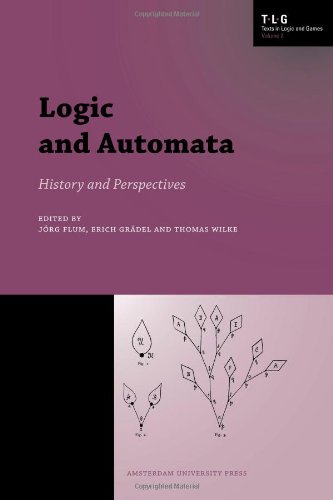
Logic and Automata: History and Perspectives
by Jorg Flum (ed)
Publisher: Amsterdam University Press 2007
ISBN/ASIN: 9053565760
ISBN-13: 9789053565766
Number of pages: 737
Description:
Mathematical logic and automata theory are two scientific disciplines with a fundamentally close relationship. This volume covers many different facets of logic and automata theory, emphasizing the connections to other disciplines such as games, algorithms, and semigroup theory, as well as discussing current challenges in the field.
Download or read it online for free here:
Download link
(5.4MB, PDF)
Similar books
 Mathematical Foundations of Automata Theory
by Jean-Eric Pin
Contents: Algebraic preliminaries; Semigroups and beyond; Languages and automata; Recognizable and rational sets; Green's relations and local theory; Profinite words; Varieties; Equations and languages; Algebraic characterisations; etc.
(9971 views)
 Introduction to Quantum Cellular Automata
by B. Aoun, M. Tarifi - arXiv
In this text the authors attempt to provide a useful introduction to quantum cellular automata from a computing perspective. For clarity and accessibility they provide a brief overview of both quantum computing and classical cellular automata.
(10278 views)
 Cellular Automata: Simplicity Behind Complexity
by Alejandro Salcido - InTech
Cellular automata make up a class of discrete dynamical systems, which are a core subject in the sciences of complexity due to their conceptual simplicity, easiness of implementation for computer simulation, and their amazingly complex behavior.
(10636 views)
 Evolution of Parallel Cellular Machines: The Cellular Programming Approach
by Moshe Sipper - Springer
Employing simple parallel cellular models, coupled with evolutionary computation techniques, this volume explores the issue of constructing man-made systems that exhibit characteristics such as those manifest by their natural counterparts.
(6531 views)