
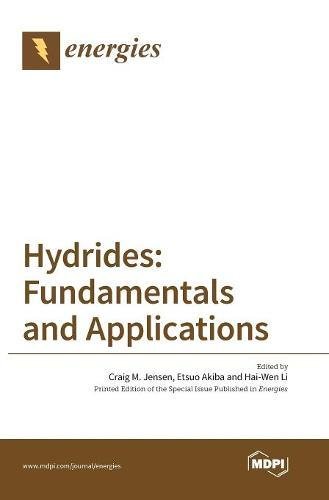
Hydrides: Fundamentals and Applications
by Craig Jensen, Etsuo Akiba, Hai-Wen Li (eds.)
Publisher: MDPI AG 2017
ISBN/ASIN: 3038422088
Number of pages: 270
Description:
The reversible elimination of hydrogen from metal hydrides serves as the basis for unique methods of energy transformation. This technology has found widespread practical utilization in applications such as hydrogen compressors, storage, and sensors, as well as batteries. Moreover, it is plausible that metal hydride technology could be utilized to provide practically viable solutions to the challenges of energy storage.
Download or read it online for free here:
Download link
(23MB, PDF)
Similar books
 Advanced Granulation Theory at Particle Level
by Peter Dybdahl Hede - BookBoon
In many types of biochemical and pharmaceutical industries fluid bed granulation in the form of agglomeration and coating processes are essential operations in the production of solid products. This text presents the relevant models and theory.
(14345 views)
 Chem1 Virtual Textbook
by Stephen Lower
Comprehensive coverage of the major topics in general chemistry at the advanced-HS and university levels. This is a reference text to supplement a conventional textbook, or the primary reading in directed-study and distance-education courses.
(24743 views)
 Nature of the Chemical Bond
by William A. Goddard III - California Institute of Technology
This text explanes the structure of molecules using quantum mechanical ideas, stressing qualitative and semi-quantitative considerations with the emphasis on developing principles that can be used to make reliable predictions on new systems.
(18369 views)
 Introductory Chemistry Online
by Paul R. Young - Wikibooks
Introductory Chemistry Online is an open-source introductory chemistry textbook/workbook that is designed cover a college-level one-semester course. The text is designed to be simple, uncluttered and very much to the point.
(12869 views)