
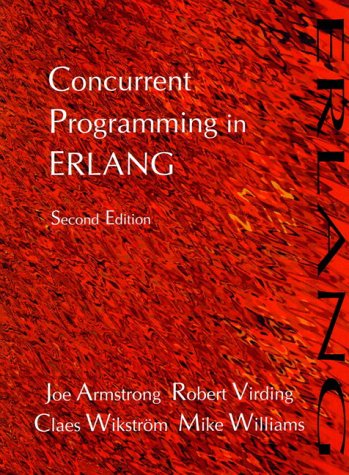
Concurrent Programming in Erlang
by Robert Virding, Claes Wikstrom, Mike Williams
Publisher: Prentice Hall PTR 1996
ISBN/ASIN: 013508301X
ISBN-13: 9780135083017
Number of pages: 205
Description:
Erlang is a concurrent, functional programming language designed for programming large industrial real time systems. The language is untyped and has a pattern matching syntax. Functions are written as a set of recursion equations and the language has explicit concurrency and asynchronous message passing. Erlang provides explicit concurrency, has asynchronous message passing and is relatively free from side effects. Written in a tutorial style, the emphasis of this book is on learning through example and a number of well known problems in designing and programming concurrent fault-tolerant real-time systems are illustrated.
Download or read it online for free here:
Download link
(860KB, PDF)
Similar books
 Petri Nets: Manufacturing and Computer Science
by Pawel Pawlewski (ed.) - InTech
The present monograph focuses on Petri Nets applications in two main areas: manufacturing and computer science. The theory of Petri Nets is still developing: some directions of investigations are presented in this volume.
(9535 views)
 Parallel Computing: Architectures, Algorithms and Applications
by C. Bischof, at al. - John von Neumann Institute for Computing
The book gives an overview of the developments, applications and future trends in high performance computing for all platforms. It addresses all aspects of parallel computing, including applications, hardware and software technologies.
(10727 views)
 PVM: Parallel Virtual Machine
by Al Geist, at al. - The MIT Press
Written by the team that developed the software, this tutorial is the definitive resource for scientists, engineers, and other computer users who want to use PVM to increase the flexibility and power of their high-performance computing resources.
(12324 views)
 A Framework for Enabling Distributed Applications on the Internet
by Mark Anthony McLaughlin - arXiv
Internet distributed applications (IDAs) are internet applications with which many users interact simultaneously. In this paper the author provides a basis for a framework that combines IDAs collectively within a single context.
(8874 views)