
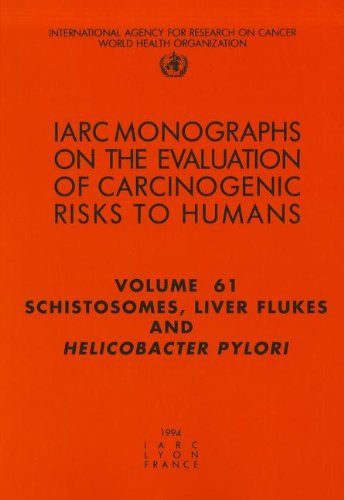
Schistosomes, Liver Flukes and Helicobacter pylori
Publisher: International Agency for Research on Cancer 1994
Number of pages: 279
Description:
This volume Evaluates the carcinogenic risk to humans posed by infection with three schistosoma trematodes, three liver flukes, and the bacterium Helicobacter pylori. These biological agents were selected for evaluation on the basis of evidence suggesting a causal association between infection and the development of human cancers.
Download or read it online for free here:
Download link
(22MB, PDF)
Similar books
 Prostate Cancer: Diagnosis and Treatment
- National Collaborating Centre for Cancer
Prostate cancer is one of the commonest cancers in men. There is evidence of practice variation around the country and of patchy availability of certain treatments. The guideline will help to address these issues and offer guidance on best practice.
(10116 views)
 Noninvasive Diagnostic Techniques for the Detection of Skin Cancers
by Susan K Parsons, et al. - Agency for Healthcare Research and Quality
The book provides a description of noninvasive imaging modalities in diagnosing cancerous tumors of the skin, proffers an analytic framework for assessing the applications of the imaging modalities, and summarizes the state of ongoing research.
(9082 views)
 Gastrointestinal Stromal Tumour
by Raimundas Lunevicius - InTech
The era of therapy for GISTs is being proclaimed as bringing the message of special importance to the pathologist role in multidisciplinary team that are responsible for treating patients with locally advanced or metastatic GIST.
(9802 views)
 Non-Hodgkin's Lymphoma: Diagnosis and Management
- National Institute for Health and Care Excellence
This guideline aims to facilitate standardisation of practice in treating non-Hodgkin's lymphoma. But because of the rapid development of new therapies as a result of improved understanding of the disease, continual re-evaluation will be essential.
(6742 views)