
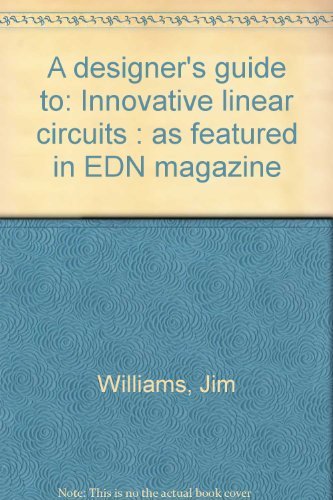
A Designer's Guide to Innovative Linear Circuits
by Jim Williams
Publisher: Cahners Pub. Co. 1985
Number of pages: 180
Description:
Analog design is not dead. Neither is interest in it. Although digital design techniques have become the primary focus of most electronics trade journals and design magazines, the need for linear applications material remains strong. Designers continue to make significant advances in linear ICs, and using these new devices is anything but a trivial task.
Download or read it online for free here:
Download link
(14MB, PDF)
Similar books
 Introduction to Electronics
by Yatindra Nath Singh, Joseph John - NPTEL
Basic idea of the course will be to introduce the basic concepts required to understand the electronic circuits. The course has been built for first year undergraduate students and targeted as general course for all branches of engineering.
(27254 views)
 Radio Hobbyist's Designbook
by Hans Summers
Radio Hobbyist's Designbook was designed to guide you into design of electronics apparatus that relates to radio. It assumes you know something about electronics, algebra and trigonometry. Topics cover the frequency spectrum of DC through VHF.
(9116 views)
 Digital Circuits
- Wikibooks
This book will serve as an introduction to Digital Circuits. It will rely heavily on the concepts of Discrete Math, but will not require any previous knowledge of the subject because all necessary math concepts will be developed in the text.
(11038 views)
 Introduction to Electronic Engineering
by Valery Vodovozov - BookBoon
This work introduces a reader to the basics of electronic engineering. Here, students may get their first knowledge of electronic concepts and basic components. Emphasis is on the devices used in day-to-day consumer electronic products.
(17291 views)