
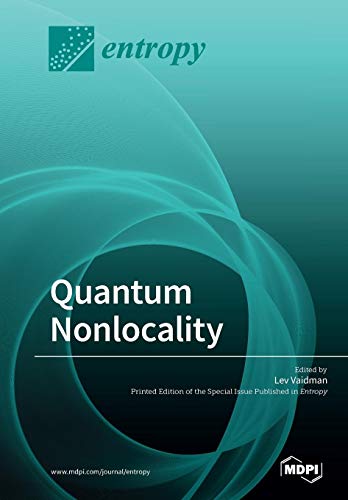
Quantum Nonlocality
by Lev Vaidman (ed.)
Publisher: MDPI AG 2019
ISBN-13: 9783038979494
Number of pages: 240
Description:
This book presents the current views of leading physicists on the bizarre property of quantum theory: nonlocality. Einstein viewed this theory as 'spooky action at a distance' which, together with randomness, resulted in him being unable to accept quantum theory. The contributions in the book describe, in detail, the bizarre aspects of nonlocality, such as Einstein-Podolsky-Rosen steering and quantum teleportation -- a phenomenon which cannot be explained in the framework of classical physics, due its foundations in quantum entanglement.
Download or read it online for free here:
Download link
(13MB, PDF)
Similar books
 Circuit QED
by Nathan K. Langford - arXiv
These notes aim to provide a non-expert introduction to the field of circuit QED, to give a basic appreciation of the promise and challenges of the field, along with a number of key concepts that will be useful for the reader who is new to the field.
(8729 views)
 Quantum Mechanics
by Martin Plenio - Imperial College
This text introduces quantum mechanics from a more abstract point of view than a first quantum mechanics course. Students will gain a deeper understanding of the structure of quantum mechanics and of some of its key points.
(18553 views)
 Quantum mechanics: An intermediate level course
by Richard Fitzpatrick - Lulu.com
Lecture notes for an upper-division quantum mechanics course: fundamental concepts, one-dimensional potentials, central potentials, angular momentum, the hydrogen atom, time-independent perturbation theory, time-dependent perturbation theory, etc.
(17090 views)
 Quantum Fluctuations
by Edward Nelson - Princeton University Press
This book deals with the kinematics of diffusion processes. The dynamical equations are derived from a variational principle, and interference, the asymptotics of free motion, bound states, statistics, and spin are described in classical terms.
(16116 views)