
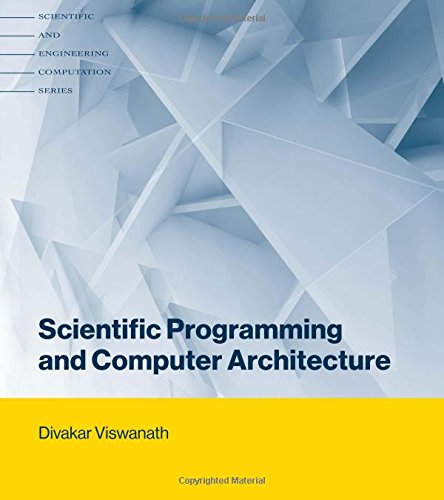
Scientific Programming and Computer Architecture
by Divakar Viswanath
Publisher: The MIT Press 2017
ISBN-13: 9780262036290
Number of pages: 624
Description:
This book examines and explains a variety of scientific programming models with an emphasis on how programming constructs map to different parts of the computer's architecture. Two themes emerge: program speed and program modularity. Throughout this book, the premise is to 'get under the hood', and the discussion is tied to specific programs.
Download or read it online for free here:
Read online
(online html)
Similar books
 SOA Source Book
- Van Haren Publishing
The SOA Source Book will help enterprise architects to use SOA effectively. It explains: What SOA is; How to evaluate SOA features in business terms; How to model SOA; How to use The Open Group Architecture Framework for SOA; SOA governance.
(13174 views)
 Case Studies in Systematic Software Development
by Cliff B. Jones and Robert C. F. Shaw - Prentice Hall
This book covers the case studies on the application of the most widely known formal methods in software development, the Vienna Development Method. VDM was developed in an industrial environment but has also evoked considerable academic research.
(14771 views)
 Software Engineering
by Ivan Marsic - Rutgers University
This book reviews some important technologies for software development with a focus on Web applications. Emphasis is on underlying principles and basic concepts. Written for upper-division undergraduate and graduate courses in software engineering.
(20047 views)
 Software Engineering with Reusable Components
by Johannes Sametinger - Springer
The book explains what is software reuse, what benefits to expect, different forms of software reuse, software components, different kinds of components, examples of successful component reuse, introduction to software engineering, and more.
(16513 views)