
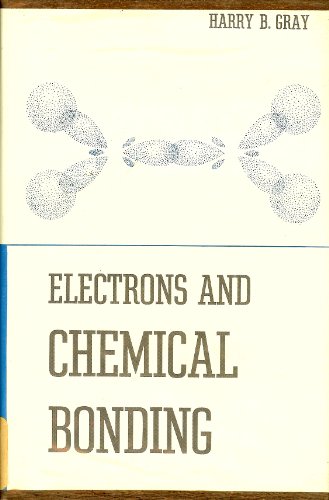
Electrons and Chemical Bonding
by Harry B. Gray
Publisher: W. A. Benjamin, Inc. 1965
ISBN/ASIN: B0007EFX9M
Number of pages: 232
Description:
An introduction to the modern theories of chemical bonding for the undergraduate student in chemistry. The book starts with a discussion of atomic structure and proceeds to the principal subject of chemical bonding. Each chapter in the bonding discussion is devoted to an important family of molecules: diatomic, linear triatomic, trigona1 planar, tetrahedral, trigonal pyramidal, and angular triatomic molecules.
Download or read it online for free here:
Download link
(21MB, PDF)
Similar books
 Introductory Chemistry
by Edward W. Pitzer - Bookboon
A brief introduction to the fundamentals of chemistry. The textbook is designed to introduce chemistry to students who will take only one chemistry course in their academic career. Certain chemistry topics are covered in a generalized manner.
(13918 views)
 CK-12 Chemistry
by S. Bewick, J. Edge, T. Forsythe, R. Parsons - CK-12 Foundation
The Atomic Theory, Electron Configurations and the Periodic Table, Ions and the Compounds They Form, Covalent Bonding, Chemical Reactions, Chemical Kinetics, Acids, Thermodynamics, Electrochemistry, Nuclear Chemistry, Organic Chemistry, and more.
(31206 views)
 General Chemistry
- Wikibooks
An introduction to the chemical world. Topics: Properties of Matter; Atomic Structure; Compounds and Bonding; Chemical Reactions; Aqueous Solutions; Phases of Matter; Chemical Equilibria; Chemical Kinetics; Thermodynamics; and more.
(15630 views)
 Multiscale Simulation Methods in Molecular Sciences
by J. Grotendorst, N. Attig, S. Bluegel, D. Marx - Julich Supercomputing Centre
Coarse graining of molecular systems and solids, quantum/classical hybrid methods, embedding and multiple time step techniques, creating reactive potentials, multiscale magnetism, adaptive resolution ideas or hydrodynamic interactions are discussed.
(14934 views)