
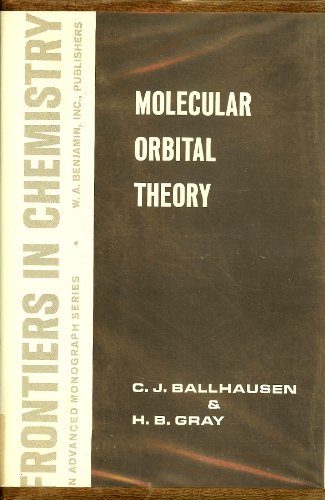
Molecular Orbital Theory
by Carl Ballhausen, Harry Gray
Publisher: W. A. Benjamin, Inc. 1965
ISBN/ASIN: 0805304517
ISBN-13: 9780805304510
Number of pages: 285
Description:
Based on lectures on molecular orbital theory that the authors have presented at the University of Copenhagen and Columbia University. They were designed primarily for advanced-undergraduate and first-year graduate students as an introduction to molecular orbital theory. The transition metal complexes occupy a special place here, and the last chapter is devoted entirely to this subject.
Download or read it online for free here:
Download link
(11MB, PDF)
Similar books
 Descriptive Chemistry
by Lyman Churchill Newell - D.C. Heath & Co
This book is intended for teachers who wish to emphasize the facts, laws, theories, and applications of chemistry. It is divided into two parts. Part I contains the text, together with exercises and problems. Part II contains the experiments.
(16898 views)
 The Basics of NMR
by Joseph P. Hornak - Rochester Institute of Technology
Nuclear magnetic resonance, or NMR as it is abbreviated by scientists, is a phenomenon which occurs when the nuclei of certain atoms are immersed in a static magnetic field and exposed to a second oscillating magnetic field.
(18437 views)
 Elements and Atoms: Case Studies in the Development of Chemistry
by Carmen Giunta - Le Moyne College
My intention here is to collect several articles by scientists who contributed to the development of knowledge about atoms and elements, and to provide sufficient background and commentary to place the work of these pioneers in context.
(16258 views)
 Advanced Maths for Chemists
by J. E. Parker - Bookboon
The third of a three part series of texts designed for a first-year university course. Tutorial questions with solutions are used to help the students to self-pace themselves. Colored molecular structures, graphs and diagrams bring the text alive.
(13460 views)