
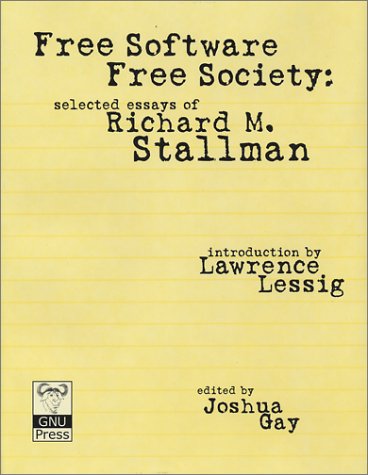
Free Software, Free Society
by Richard M. Stallman
Publisher: Free Software Foundation 2002
ISBN/ASIN: 1882114981
ISBN-13: 9781882114986
Number of pages: 230
Description:
The intersection of ethics, law, business and computer software is the subject of these essays and speeches by MacArthur Foundation Grant winner, Richard M. Stallman. This collection includes historical writings such as The GNU Manifesto, which defined and launched the activist Free Software Movement, along with new writings on hot topics in copyright, patent law, and the controversial issue of "trusted computing." Stallman takes a critical look at common abuses of copyright law and patents when applied to computer software programs, and how these abuses damage our entire society and remove our existing freedoms.
Download or read it online for free here:
Download link
(2.3MB, PDF)
Similar books
 The Future of Reputation: Gossip, Rumor, and Privacy on the Internet
by Daniel J. Solove - Yale University Press
A fascinating account of how the Internet is transforming gossip and our ability to protect our own reputations. The author shows that the unconstrained flow of information on the Internet may impede opportunities for self-development and freedom.
(16781 views)
 Coding Freedom: The Ethics and Aesthetics of Hacking
by E. Gabriella Coleman - Princeton University Press
Exploring the rise and political significance of the free and open source software movement in the US and Europe, the book details the political struggles through which hackers question the scope and direction of copyright and patent law.
(6321 views)
 Interfaces on Trial 2.0
by Jonathan Band, Masanobu Katoh - The MIT Press
This book -- a follow-up to Band and Katoh's successful 1995 book Interfaces on Trial -- examines the debates surrounding the use of copyright law to prevent competition and interoperability in the global software industry in the last fifteen years.
(8144 views)
 Digital Copyright
by Jessica Litman - Michigan Publishing Services
Jessica Litman questions whether copyright laws crafted by lawyers and their lobbyists really make sense for the vast majority of us. Should every interaction between ordinary consumers and copyright-protected works be restricted by law?
(7214 views)