
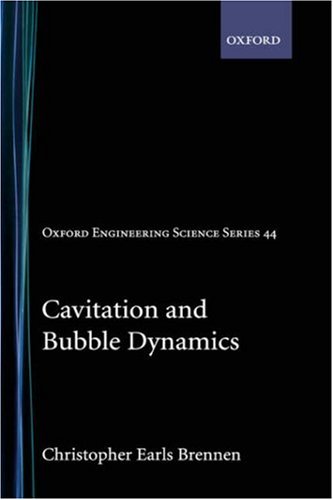
Cavitation and Bubble Dynamics
by Christopher E. Brennen
Publisher: Oxford University Press 1995
ISBN/ASIN: 0195094093
ISBN-13: 9780195094091
Number of pages: 294
Description:
This book provides a coherent and unified treatment of the fundamental physical processes involved in bubble dynamics and the phenomenon of cavitation. Of interest to a wide range of mechanical engineers, the study of cavitation and bubbly flows is applicable to topics ranging from valve damage in hydroelectric equipment, ship propellers, and internal combustion engines to the performance of turbines and pumps of all sizes. Well-written and up-to-date, the book will prove indispensable to engineers and students needing a reference detailing the problems of cavitation and bubbly flow.
Download or read it online for free here:
Download link
(5.8MB, PDF)
Similar books
 Computational Fluid Dynamics
by Hyoung Woo Oh - InTech
This book is intended to serve as a reference text for advanced scientists and research engineers to solve a variety of fluid flow problems using computational fluid dynamics. Chapters are contributed by the practiced experts in the field.
(18606 views)
 Lecture Notes on Gas Dynamics
by Joseph M. Powers - University of Notre Dame
These are a set of class notes for a gas dynamics/viscous flow course taught to juniors in Aerospace Engineering. It is expected that the student has some familiarity with concepts such as material derivatives, control volume analysis, etc.
(12960 views)
 Hydrostatics and Pneumatics
by Philip Magnus - Longmans
This Class-Book is intended for those who have already acquired some elementary knowledge of Mechanics, and are about to commence the study of Hydrostatics and Pneumatics. The author combines the Experimental with the Deductive method.
(14864 views)
 Wind Tunnels
by Satoru Okamoto - InTech
This book collects original research studies on recent applications in wind tunnel tests, exhibiting various investigation directions and providing a bird's eye view on this broad subject area. Addressed to researchers and professional engineers.
(21074 views)