
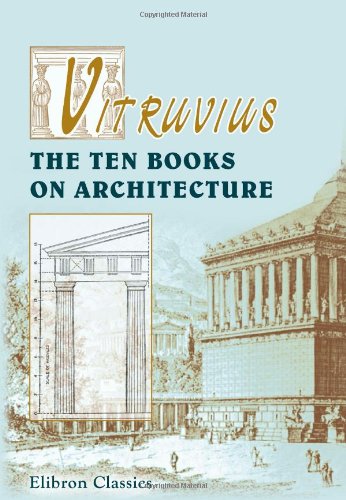
Vitruvius: The Ten Books on Architecture
by Marcus Vitruvius Pollio
Publisher: Harvard University Press 1914
ISBN/ASIN: 1421270110
Number of pages: 380
Description:
The only full treatise on architecture and its related arts to survive from classical antiquity, this is the single most important work of architectural history in the Western world, having shaped architecture and the image of the architect from the Renaissance to the present. Demonstrating the range of Vitruvius' style, this new edition includes examples from archaeological sites discovered since World War II and not previously published in English language translations. Vitruvius emerges as an inventive and creative thinker, rather than the normative summarizer, as he was characterized in the Middle Ages and Renaissance.
Download or read it online for free here:
Download link
(multiple formats)
Similar books
 Cities Full of Symbols: A Theory of Urban Space and Culture
by Peter J. M. Nas (ed.) - Leiden University Press
The book develops urban symbolic ecology and hypercity approaches into a new perspective on social cohesion. Architects, sociologists and historians converge to make this a book for anyone interested in urban life, policymaking and city branding.
(11165 views)
 Methods and Techniques in Urban Engineering
by A. C. de Pina Filho and A. C. de Pina - InTech
Topics covered: urban automation; geographic information systems; urban noise, floods and transports; information technology applied to the cities; tools for urban simulation, social monitoring and control of urban policies; sustainability; etc.
(16340 views)
 Rural Architecture
by Lewis Falley Allen - ManyBooks
A complete description of farm houses, cottages, and out buildings, comprising wood houses, workshops, tool houses, carriage and wagon houses, stables, smoke and ash houses, ice houses, apiary or bee house, poultry houses, rabbitry, dovecote, etc.
(16643 views)
 Moving to Sustainable Buildings
by Umberto Berardi - De Gruyter Open
Umberto Berardi explores the transition to sustainable building through the adoption of green innovations. The author describes how organisational models among stakeholders are changing as the sector moves towards a green economy.
(8096 views)