
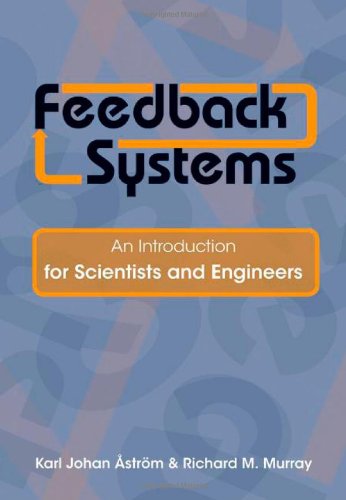
Feedback Systems: An Introduction for Scientists and Engineers
by Karl J. Astrom, Richard M. Murray
Publisher: Princeton University Press 2008
ISBN/ASIN: 0691135762
ISBN-13: 9780691135762
Number of pages: 408
Description:
This book provides an introduction to the basic principles and tools for the design and analysis of feedback systems. It is intended to serve a diverse audience of scientists and engineers who are interested in understanding and utilizing feedback in physical, biological, information and social systems. A major goal of this book is to present a concise and insightful view of the current knowledge in feedback and control systems.
Download or read it online for free here:
Download link
(11MB, PDF)
Similar books
 Nonlinear System Theory: The Volterra/Wiener Approach
by Wilson J. Rugh - The Johns Hopkins University Press
Contents: Input/Output Representations in the Time and Transform Domain; Obtaining Input/Output Representations from Differential-Equation Descriptions; Realization Theory; Response Characteristics of Stationary Systems; Discrete-Time Systems; etc.
(14072 views)
 Adaptive Control
by Kwanho You - InTech
This book discusses the issues of adaptive control application to model generation, adaptive estimation, output regulation and feedback, electrical drives, optical communication, neural estimator, simulation and implementation.
(19560 views)
 Feedback Control Theory
by John Doyle, Bruce Francis, Allen Tannenbaum
The book presents a theory of feedback control systems. It captures the essential issues, can be applied to a wide range of practical problems, and is as simple as possible. Addressed to students who have had a course in signals and systems.
(16922 views)
 Systems Structure and Control
by Petr Husek - InTech
The the book covers broad field of theory and applications of many different control approaches applied on dynamic systems. Output and state feedback control include among others robust control, optimal control or intelligent control methods.
(14256 views)