
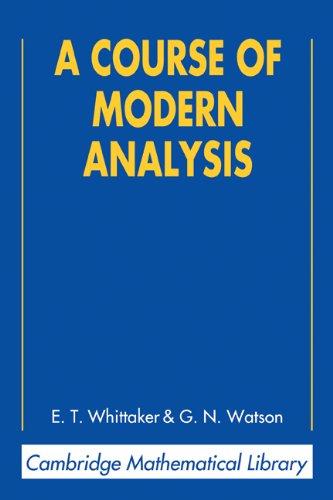
A Course of Modern Analysis
by E. T. Whittaker, G. N. Watson
Publisher: Cambridge University Press 1920
Number of pages: 608
Description:
This classic text has entered and held the field as the standard book on the applications of analysis to the transcendental functions. The authors explain the methods of modern analysis in the first part of the book and then proceed to a detailed discussion of the transcendental function, unhampered by the necessity of continually proving new theorems for special applications. In this way the authors have succeeded in being rigorous without imposing on the reader the mass of detail that so often tends to make a rigorous demonstration tedious. Researchers and students will find this book as valuable as ever.
Download or read it online for free here:
Download link
(multiple formats)
Similar books
 Set Theory and Topology: An Introduction to the Foundations of Analysis
by Felix Nagel - arXiv
We provide a formal introduction into the classic theorems of general topology and its axiomatic foundations in set theory. The exposition in this first part includes relation and order theory as well as a construction of number systems.
(12223 views)
 Introduction to Methods of Applied Mathematics
by Sean Mauch - Caltech
Advanced mathematical methods for scientists and engineers, it contains material on calculus, functions of a complex variable, ordinary differential equations, partial differential equations and the calculus of variations.
(19347 views)
 Reader-friendly Introduction to the Measure Theory
by Vasily Nekrasov - Yetanotherquant.de
This is a very clear and user-friendly introduction to the Lebesgue measure theory. After reading these notes, you will be able to read any book on Real Analysis and will easily understand Lebesgue integral and other advanced topics.
(13133 views)
 An Introduction to Asymptotic Analysis
by Simon J.A. Malham - Heriot-Watt University
From the table of contents: Order notation; Perturbation methods; Asymptotic series; Laplace integrals (Laplace's method, Watson's lemma); Method of stationary phase; Method of steepest descents; Bibliography; Notes; Exam formula sheet; etc.
(7193 views)