
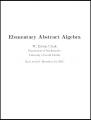
Elementary Abstract Algebra
by W. Edwin Clark
Publisher: University of South Florida 2001
Number of pages: 105
Description:
This book is written as a one semester introduction to abstract algebra. The author does not spend a lot of time with background material, he goes directly into the subject matter. Applications of abstract algebra are not discussed, the thought processes one learns in this text is more valuable than the subject matter. Some familiarity with basic set theory, calculus, and linear algebra, is assumed.
Download or read it online for free here:
Download link
(0.5MB, PDF)
Similar books
 Intro to Abstract Algebra
by Paul Garrett
The text covers basic algebra of polynomials, induction, sets, counting principles, integers, unique factorization into primes, Sun Ze's theorem, good algorithm for exponentiation, Fermat's little theorem, Euler's theorem, public-key ciphers, etc.
(14257 views)
 Basic Algebra
by Anthony W. Knapp
Contents: Preliminaries about the Integers, Polynomials, and Matrices; Vector Spaces over Q, R, and C; Inner-Product Spaces; Groups and Group Actions; Theory of a Single Linear Transformation; Multilinear Algebra; Advanced Group Theory; etc.
(9039 views)
 Algebra: Abstract and Concrete
by Frederick M. Goodman - Semisimple Press
An introduction to modern and abstract algebra at upper undergraduate level and beginning graduate students. The book treats conventional topics: linear algebra, groups, rings, fields, and symmetry as a unifying concept.
(42058 views)
 Abstract Algebra I
by Marcel B. Finan - Arkansas Tech University
Contents: Concept of a Mapping; Composition; Binary Operations; Composition of Mappings as a Binary Operation; Definition and Examples of Groups; Permutation Groups; Subgroups; Symmetry Groups; Equivalence Relations; The Division Algorithm; etc.
(12922 views)