
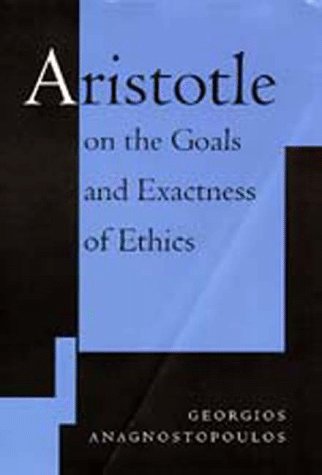
Aristotle on the Goals and Exactness of Ethics
by Georgios Anagnostopoulos
Publisher: University of California Press 1994
ISBN/ASIN: 0520081250
ISBN-13: 9780520081253
Number of pages: 474
Description:
The author offers the most systematic critical examination to date of Aristotle's views on the exactness of ethics. Combining rigorous philosophical argument and analysis of the philosopher's treatises on human conduct, he gives form to Aristotle's belief that knowledge of matters of conduct can never be free of certain kinds of inexactness. He concludes that according to Aristotle, ethics constitutes a mode of knowledge that is neither totally nondemonstrative on account of its inexactness nor free of the important epistemological difficulties common to all nonmathematical disciplines.
Download or read it online for free here:
Read online
(online reading)
Similar books
 Against War
by Desiderius Erasmus - The Merrymount Press
War was shocking to Erasmus alike on every side of his remarkably complex and sensitive nature. It was impious; it was inhuman; it was ugly; it was in every sense of the word barbarous, to one who before all things was a lover of civilization.
(6967 views)
 Animals and Ethics 101
by Nathan Nobis - Open Philosophy Press
The book presupposes no conclusions on the controversial moral questions about the treatment of animals, and argues for none either. Its goal is to help the reader better engage the issues and arguments on all sides with greater clarity.
(5024 views)
 The Foundations of Morality
by Henry Hazlitt - Von Mises Institute
A philosophical work, in which the author grounds a policy of private property and free markets in an ethic of classical utilitarianism. Hazlitt writes on the relationship between economics and the good of society in general.
(13773 views)
 A Modern Theory of Ethics: A study of the Relations of Ethics and Psychology
by W. Olaf Stapledon
The author has chosen to examine certain modern ethical theories (which themselves seek to embody what is best in ancient thought about the good), and these he has considered in relation with other contemporary movements of the mind.
(12222 views)