
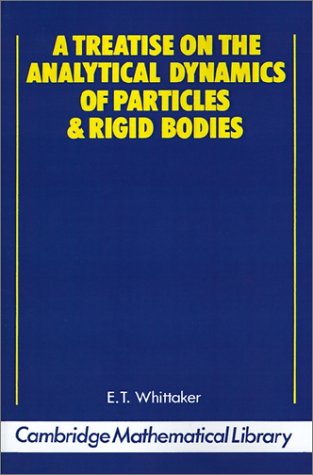
A Treatise on the Analytical Dynamics of Particles and Rigid Bodies
by E. T. Whittaker
Publisher: Cambridge University Press 1917
ISBN/ASIN: 0521358833
Number of pages: 460
Description:
The name Analytical Dynamics is given to that branch of knowledge in which the motions of material bodies, considered as due to the mutual interactions of the bodies, are discussed by the aid of mathematical analysis. There are few books on mathematical mechanics as famous as this, a work that forms a comprehensive account of all the classical results of analytical dynamics.
Download or read it online for free here:
Download link
(multiple formats)
Similar books
 Topics in dynamics I: Flows
by Edward Nelson - Princeton University Press
Lecture notes for a course on differential equations covering differential calculus, Picard's method, local structure of vector fields, sums and Lie products, self-adjoint operators on Hilbert space, commutative multiplicity theory, and more.
(20527 views)
 Applied Mechanics Dynamics
by G. W. Housner, D. E. Hudson - California Institute of Technology
Textbook for engineering students who wish to prepare for more advanced studies of dynamics. The emphasis is on particle and rigid-body dynamics. The book shows how the classical mechanics methods are applied to the various branches of engineering.
(18854 views)
 Classical Dynamics
by David Tong - University of Cambridge
We shall describe the advances that took place after Newton when the laws of motion were reformulated using more powerful techniques and ideas developed by some of the giants of mathematical physics: Euler, Lagrange, Hamilton and Jacobi.
(12962 views)
 Newtonian Dynamics
by Richard Fitzpatrick - Lulu.com
Set of lecture notes for an upper-division classical dynamics course: oscillations, Keplerian orbits, two-body scattering, rotation of rigid bodies in three dimensions, Lagrangian mechanics, Hamiltonian mechanics, and coupled oscillations.
(17937 views)