
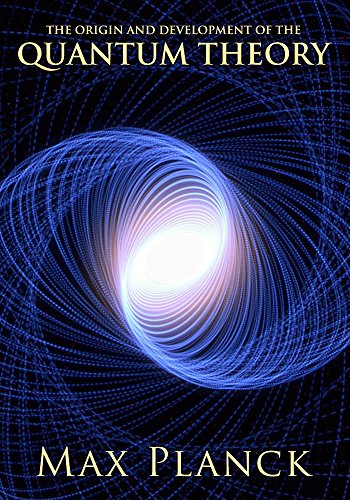
The origin and development of the quantum theory
by Max Planck
Publisher: The Clarendon press 1922
Number of pages: 32
Description:
"The origin and development of the quantum theory" is Max Planck's Nobel prize address delivered before the Royal Swedish Academy of Sciences at Stockholm, 2 June, 1920. Planck sketches in outline the history of the origin of the Quantum Theory and gives a brief account of the development of this theory and its influence on the Physics of the present day.
Download or read it online for free here:
Download link
(multiple formats)
Similar books
 Quantum Mechanics: Lecture Notes on Quantum Chemistry
by Eric R. Bittner - University of Houston
Contents: Survey of Classical Mechanics; Waves and Wavefunctions; Semi-Classical Quantum Mechanics; Postulates of Quantum Mechanics; Bound States of Schroedinger Equation; Quantum Mechanics 3D; Perturbation theory; Many Body Quantum Mechanics.
(11076 views)
 Quantum Mechanics for Engineers
by Leon van Dommelen
This book was written for engineering graduate students who find themselves caught up in nano technology. The first part of the book provides a solid introduction to classical quantum mechanics, the second part discusses more advanced topics.
(23470 views)
 Heisenberg: Uncertainty
by David C. Cassidy - American Institute of Physics
The uncertainty principle is explained with text, pictures and voice clips. Heisenberg's leading biographer tells the full story of this eventful life, including the physicist's controversial role in Nazi Germany's nuclear program.
(17555 views)
 Quantum Physics
by James G. Branson - UCSD
This set of notes covers a 3 quarter advanced undergraduate quantum physics course at UCSD, from the beginning of Quantum Mechanics to the quantization of the electromagnetic field and the Dirac equation. Lecture videos are included.
(14074 views)