
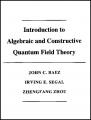
Introduction to Algebraic and Constructive Quantum Field Theory
by John C. Baez, Irving E. Segal, Zhengfang Zhou
Publisher: Princeton University Press 1992
ISBN/ASIN: 0691085463
ISBN-13: 9780691085463
Number of pages: 316
Description:
The authors present a rigorous treatment of the first principles of the algebraic and analytic core of quantum field theory. Their aim is to correlate modern mathematical theory with the explanation of the observed process of particle production and of particle-wave duality that heuristic quantum field theory provides. The authors address readers interested in fundamental mathematical physics and who have at least the training of an entering graduate student.
Download or read it online for free here:
Download link
(PDF, DJVU)
Similar books
 Introduction to Renormalisation
by Joao F. Melo - arXiv
These are introductory lectures aimed at beginning graduate students covering fundamental concepts and ideas behind the renormalisation group. Our main goal is to motivate it and then explore its consequences, in the context of quantum field theory.
(1042 views)
 Introduction to Nonequilibrium Quantum Field Theory
by J. Berges - arXiv
An introduction to functional integral techniques and how they can be applied in practice. Though we focus on particle physics and cosmology applications, we emphasize that these techniques can be equally applied to other nonequilibrium phenomena.
(9970 views)
 Quantum Field Theory
by David Tong - University of Cambridge
These notes are based on an introductory course on quantum field theory. From the table of contents: Classical Field Theory; Free Fields; Interacting Fields; The Dirac Equation; Quantizing the Dirac Field; Quantum Electrodynamics.
(12545 views)
 Quantum Field Theory
by A.N. Schellekens
All particles in the standard model correspond to some field in a quantum field theory. Our task is to understand how this works, how to describe interactions of these particles using quantum field theory, and how to compute various processes.
(11093 views)