
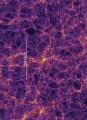
The Cosmic Web: Geometric Analysis
by Rien van de Weygaert, Willem Schaap
Publisher: arXiv 2007
Number of pages: 129
Description:
The lecture notes describe the Delaunay Tessellation Field Estimator for Cosmic Web analysis. The high sensitivity of Voronoi/Delaunay tessellations to the local point distribution is used to obtain estimates of density and related quantities. The adaptive and minimum triangulation properties of Delaunay tessellations are utilized for interpolation to continuous volume-covering density and velocity fields.
Download or read it online for free here:
Download link
(3MB, PDF)
Similar books
 Cosmology for Particle Physicists
by U. A. Yajnik - arXiv
We begin with a recapitulation of General Relativity, and the Standard Model of Cosmology. This is followed by lectures on inflation, density perturbations, study of hot and cold relics decoupled from the remaining constituents, and baryon asymmetry.
(15809 views)
 Dark Energy: Observational Evidence and Theoretical Models
by B. Novosyadlyj, V. Pelykh, Yu. Shtanov, A. Zhuk - Akademperiodyka
The book elucidates the current state of the dark energy problem and presents the results of the authors, who work in this area. It describes the observational evidence for the existence of dark energy, the methods of constraining of its parameters.
(11000 views)
 Advanced Topics in Cosmology: A Pedagogical Introduction
by T. Padmanabhan - arXiv
Here is an introduction to several advanced topics in contemporary cosmology. Topics covered: the thermal history of the universe, linear perturbation theory, theory of CMBR temperature anisotropies and the inflationary generation of perturbation.
(11453 views)
 Dynamics of the Universe in Problems
by Yu. L. Bolotin, et al. - UniverseInProblems.com
Problem book on cosmology that includes its spectacular recent achievements. There are over 1000 problems, covering topics from the dynamics of the expanding Universe and CMB to cosmology beyond the Lambda-CDM model and holography.
(11046 views)