
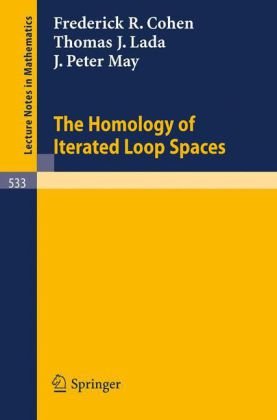
The Homology of Iterated Loop Spaces
by F. R. Cohen, T. J. Lada, P. J. May
Publisher: Springer 2009
ISBN/ASIN: 354007984X
ISBN-13: 9783540079842
Number of pages: 490
Description:
This volume is a collection of five papers. The first four together give a thorough treatment of homology operations and of their application to the calculation of, and analysis of internal structure in, the homologies of various spaces of interest. The last studies an up to homotopy notion of an algebra over a monad and the role of this notion in the theory of iterated loop spaces.
Download or read it online for free here:
Download link
(15MB, PDF)
Similar books
 Lecture Notes on Motivic Cohomology
by Carlo Mazza, Vladimir Voevodsky, Charles Weibel - AMS
This book provides an account of the triangulated theory of motives. Its purpose is to introduce Motivic Cohomology, to develop its main properties, and finally to relate it to other known invariants of algebraic varieties and rings.
(9361 views)
 Manifold Theory
by Peter Petersen - UCLA
These notes are a supplement to a first year graduate course in manifold theory. These are the topics covered: Manifolds (Smooth Manifolds, Projective Space, Matrix Spaces); Basic Tensor Analysis; Basic Cohomology Theory; Characteristic Classes.
(9275 views)
 Topology Lecture Notes
by Thomas Ward - UEA
Contents: Topological and Metric Spaces, Homotopy Exquivalence, Fundamental Groups, Covering Spaces and Applications, Classification of Surfaces, Simplicial Complexes and Homology Groups, Homology Calculations, Simplicial Approximation, etc.
(11754 views)
 Modern Algebraic Topology
by D. G. Bourgin - Macmillan
Contents: Preliminary algebraic background; Chain relationships; The absolute homology groups and basic examples; Relative omology modules; Manifolds and fixed cells; Omology exact sequences; Simplicial methods and inverse and direct limits; etc.
(7322 views)