
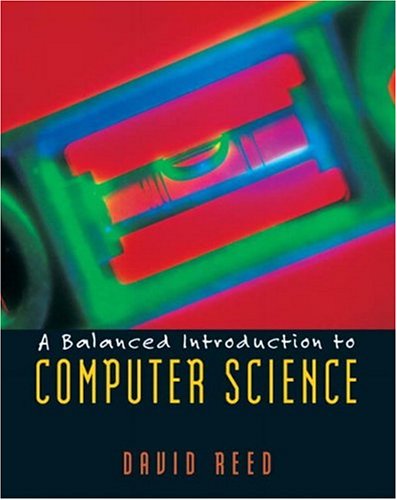
A Balanced Introduction to Computer Science
by David Reed
Publisher: Prentice Hall 2004
ISBN/ASIN: 013046709X
ISBN-13: 9780130467096
Number of pages: 400
Description:
The book covers concepts and issues in computing that are most relevant to the beginning student, including computer terminology, the Internet and World Wide Web, the history of computing, the organization and manufacture of computer technology, and technology's impact on society. Mixed among these breadth topics are chapters that introduce fundamental programming concepts and skills in a hands-on, tutorial format.
Download or read it online for free here:
Download link
(multiple PDF files)
Similar books
 The Fourth Paradigm: Data-Intensive Scientific Discovery
by Tony Hey, Stewart Tansley, Kristin Tolle - Microsoft Research
The Fourth Paradigm, the collection of essays expands on the vision of pioneering computer scientist Jim Gray for a new, fourth paradigm of discovery based on data-intensive science and offers insights into how it can be fully realized.
(18125 views)
 Introduction to High-Performance Scientific Computing
by Victor Eijkhout - University of Texas
A computational scientist needs knowledge of several aspects of numerical analysis and discrete mathematics. This text covers: computer architecture, parallel computers, machine arithmetic, numerical linear algebra, applications.
(14117 views)
 Common LISP: A Gentle Introduction to Symbolic Computation
by David S. Touretzky - Benjamin-Cummings Pub Co
This is a gentle introduction to Common Lisp for students taking their first programming course. No prior mathematical background beyond arithmetic is assumed. There are lots of examples, the author avoided technical jargon.
(27566 views)
 Introduction to Soft Computing
by Eva Volna - Bookboon
This book gives an introduction to Soft Computing, which aims to exploit tolerance for imprecision, uncertainty, approximate reasoning, and partial truth in order to achieve close resemblance with human like decision making.
(9597 views)