
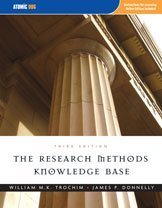
The Research Methods Knowledge Base
by William Trochim, James P. Donnelly
Publisher: Atomic Dog 2006
ISBN/ASIN: 1592602916
ISBN-13: 9781592602919
Number of pages: 361
Description:
The Research Methods Knowledge Base is a comprehensive web-based textbook that addresses all of the topics in a typical introductory undergraduate or graduate course in social research methods. It covers the entire research process including: formulating research questions; sampling (probability and nonprobability); measurement (surveys, scaling, qualitative, unobtrusive); research design (experimental and quasi-experimental); data analysis; and, writing the research paper.
Download or read it online for free here:
Read online
(online html)
Similar books
 Globalization and the City: Two Connected Phenomena in Past and Present
by Andreas Exenberger, et al. - Innsbruck University Press
This book is dedicated to contribute to the growing literature connecting the history of cities worldwide and their relation to global processes. The authors do so from various disciplinary backgrounds and by referring to different times and places.
(8217 views)
 Meet Me at the Fair: A World's Fair Reader
by Laura Hollengreen, et al. - ETC Press
The authors investigate world's fairs in their multiple aspects: political, sociological, commercial, popular... The volume presents its own phantasmagoria of disciplinary perspectives, historical periods, geographical locales, media, and messages.
(6059 views)
 Basic Concepts: The Methodology of the Social Sciences
by Johann Mouton, H.C. Marais - HSRC Press
This is one of the leading methodology textbooks in South African tertiary education. It provides an introduction to the fundamental concept of social science research, and complements books on specific research methods and techniques.
(16066 views)
 The Counter-Revolution of Science
by Friedrich A. Hayek - Free Press
A group of thinkers concluded that an elite of social scientists should assume direct control of social life. The Counter-Revolution of Science is Nobel Laureate Friedrich Hayek's forceful attack on this abuse of reason.
(14428 views)