
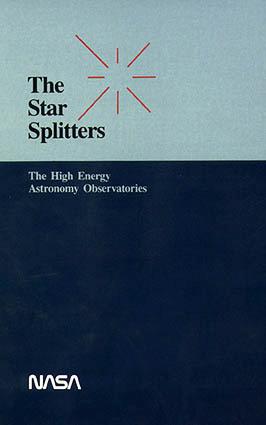
The Star Splitters: The High Energy Astronomy Observatories
by Wallace H. Tucker
Publisher: NASA History Office 1984
ISBN/ASIN: 9997398823
ISBN-13: 9789997398826
Number of pages: 182
Description:
This book published in 1984 describes the High Energy Astronomy Observatory (HEAO) Missions which were developed to examine and analyze the nature of the high energy universe, stellar radiation and galactic radiation. Some of the topics covered in this book include creative violence, stellar explosions, cosmic rays, superbubbles, stellar coronas, collapsed stars, neutron stars, degenerate dwarf stars, black holes, X-ray images of galaxies, galactic nuclei, spiral galaxies, galactic clusters, the mystery of the missing mass, and cosmic fire.
Download or read it online for free here:
Read online
(online html)
Similar books
 Spherical Astronomy
by F. Brünnow - Van Nostrand
The celestial sphere and its diurnal motion; On the changes of the fundamental planes to which the places of the stars are referred; Corrections of the observations arising from the position of the observer on the surface of the Earth; and more.
(13062 views)
 Gravitational Wave Detection by Interferometry
by Matthew Pitkin, Stuart Reid, Sheila Rowan, Jim Hough - arXiv
The main theme of this review is a discussion of the mechanical and optical principles used in the various long baseline systems in operation around the world - LIGO, Virgo, TAMA300, LCGT, GEO600 - and in LISA, a proposed space-borne interferometer.
(9273 views)
 Practical Astronomy for Engineers
by Frederick Hanley Seares - Stephens
The main purpose of the volume is an exposition of the principal methods of determining latitude, azimuth, and time. Generally speaking, the limit of precision is that corresponding to the engineer's transit or the sextant.
(18440 views)
 Atomic and Molecular Processes in Astronomy and Planetary Science
by Geoffrey A. Blake - California Institute of Technology
This course discusses the fundamental aspects of atomic and molecular spectra that enable one to infer physical conditions in astronomical, planetary and terrestrial environments from the analysis of their electromagnetic radiation.
(13692 views)