
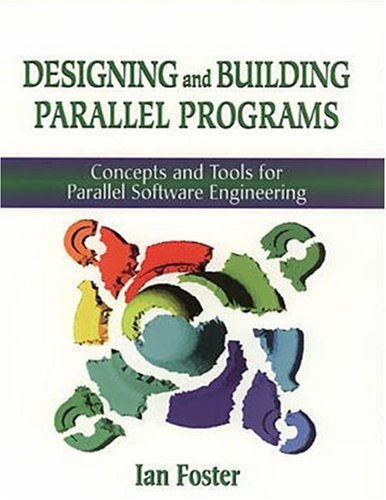
Designing and Building Parallel Programs
by Ian Foster
Publisher: Addison Wesley 1995
ISBN/ASIN: 0201575949
ISBN-13: 9780201575941
Number of pages: 430
Description:
Designing and Building Parallel Programs is a book for students and professionals who need to know how to write parallel programs. It is neither a programming language manual nor an academic treatise on algorithms. Instead, it approaches parallel programming as an engineering activity, in which programs are developed in a methodical fashion and both cost and performance are considered at each stage in a design. It is intended as both an introduction to parallel programming and a practitioner's guide for programmers, engineers, and scientists developing programs for parallel and distributed computer systems.
Download or read it online for free here:
Read online
(online html)
Similar books
 Programming on Parallel Machines
by Norm Matlo ff - University of California, Davis
This book is aimed more on the practical end of things, real code is featured throughout. The emphasis is on clarity of the techniques and languages used. It is assumed that the student is reasonably adept in programming and linear algebra.
(8990 views)
 An introduction to one-way quantum computing in distributed architectures
by Earl T. Campbell, Joseph Fitzsimons - arXiv
This review provides a gentle introduction to one-way quantum computing in distributed architectures. One-way quantum computation shows significant promise as a model for distributed systems, particularly probabilistic entangling operations.
(9754 views)
 Introduction to Parallel Computing
by Blaise Barney - Lawrence Livermore National Laboratory
This tutorial covers the very basics of parallel computing, and is intended for someone who is just becoming acquainted with the subject. It begins with a brief overview, including concepts and terminology associated with parallel computing.
(12745 views)
 Parallel and Distributed Computation: Numerical Methods
by Dimitri P. Bertsekas, John Tsitsiklis - Athena Scientific
This is a comprehensive and theoretically sound treatment of parallel and distributed numerical methods. It focuses on algorithms that are naturally suited for massive parallelization, and it explores the issues associated with such algorithms.
(11696 views)