
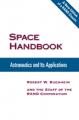
Space Handbook
by Robert W. Buchheim
Publisher: RAND Corporation 2007
ISBN/ASIN: 0833042238
ISBN-13: 9780833042231
Number of pages: 348
Description:
Written as a basic guide on the uses and characteristics of space systems, this book discusses astronautics and its applications, technology in the space environment, rocket vehicles, propulsion systems, propellants, internal power sources, structures and materials, flight path and orientation control, guidance, communication, observation and tracking, and atmospheric flight. This is a reprint of an edition originally published in 1958.
Download or read it online for free here:
Download link
(12MB, PDF)
Similar books
 Beyond Horizons: A Half Century of Air Force Space Leadership
by David N. Spires - AU Press
This book tells the story of the origins and development of the United States Air Force's space program from its earliest beginnings in the post Second World War period to its emergence as a critical operational presence in the Persian Gulf War.
(14614 views)
 Aerospace Technologies Advancements
by Thawar T. Arif - InTech
Space technology has become increasingly important after the great development and rapid progress in information and communication technology. This book deals with the latest and most prominent research in space technology.
(15035 views)
 NASA at 50: Interviews with NASA's Senior Leadership
by Rebecca Wright, Sandra Johnson, Steven J. Dick - NASA
The 50th anniversary of NASA on 1 October 2008 found an agency in the midst of deep transition. This volume provides a snapshot of the thinking of NASA senior leadership on the occasion of its 50th anniversary and in the midst of these sea changes.
(10284 views)
 Orders of Magnitude: A History of the NACA and NASA, 1915-1990
by Roger E. Bilstein - United States Government Printing
This is a concise history of NACA and its successor agency, NASA. This edition not only updates the historical record, but restores aeronautics to its due place in the history of the agency and of mankind's most fascinating and continuing voyage.
(16550 views)