
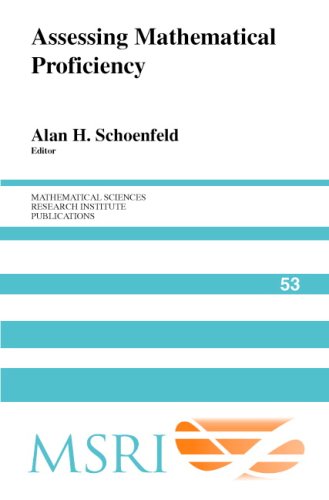
Assessing Mathematical Proficiency
by Alan H. Schoenfeld
Publisher: Cambridge University Press 2007
ISBN/ASIN: 0521874920
ISBN-13: 9780521874922
Number of pages: 391
Description:
Testing matters! It can determine kids' and schools' futures. In a conference at the Mathematical Sciences Research Institute, mathematicians, math education researchers, teachers, test developers, and policymakers gathered to work through critical issues related to mathematics assessment. This volume presents the results of the discussions. It highlights the kinds of information that different assessments can offer, including many examples of some of the best mathematics assessments worldwide.
Download or read it online for free here:
Download link
(multiple PDF files)
Similar books
 Teaching and Learning of Calculus
by David Bressoud, et al. - Springer Open
This text focuses on the main trends in the field of calculus education. The findings reveal a cornerstone issue that is strongly linked to the formalism of calculus concepts and to the difficulties it generates in the learning and teaching process.
(6885 views)
 The Experimental Mathematician: The Pleasure of Discovery and the Role of Proof
by Jonathan M. Borwein - Dalhousie University
The emergence of powerful mathematical computing environments, the growing availability of correspondingly powerful computers and the pervasive presence of the internet allow for mathematicians to proceed heuristically and quasi-inductively.
(12634 views)
 A First Course in Mathematics Concepts for Elementary School Teachers
by Marcel B. Finan - Arkansas Tech University
Problem-solving is the cornerstone of school mathematics. The techniques discussed in this book should help you to become a better problem solver and should show you how to help others develop their problem-solving skills.
(19786 views)
 On the Study and Difficulties of Mathematics
by Augustus De Morgan - The Open Court Publishing
In compiling the following pages, my object has been to notice particularly several points in the principles of algebra and geometry, which have not obtained their due importance in our elementary works on these sciences.
(10436 views)