
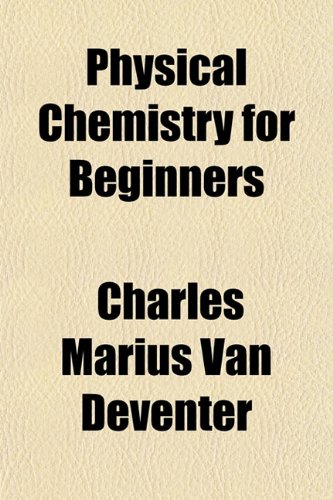
Physical Chemistry for Beginners
by Charles Marius Deventer
Publisher: John Wiley & Sons 1903
ISBN/ASIN: 1151031968
Number of pages: 200
Description:
In the book at hand the author has endeavored to collect the most important results of physical chemistry in such a manner that this important branch of modern chemistry may be accessible to those who have not made an exhaustive study of physics and mathematics. The requirements of students of medicine and pharmacy, as well as of elementary chemistry, have been especially considered in the preparation of this work.
Download or read it online for free here:
Download link
(multiple formats)
Similar books
 Quantum Chemistry
by S. M. Blinder, Elvera Baron - University of Michigan
This course is designed to introduce students to a thorough, research-oriented view of Physical Chemistry. Students will solve the Schroedinger equation in 1-, 2-, and 3-dimensions for several problems of interest in chemistry.
(15211 views)
 Physical Chemistry in Brief
by J.P. Novak, S. Labik, I. Malijevska - Institute of Chemical Technology, Prague
The book covers the fundamental concepts of physical chemistry: state behaviour of gases, liquids, and solids, chemical thermodynamics, phase equilibrium, chemical equilibrium, electrochemistry, chemical kinetics and transport processes, etc.
(13089 views)
 Chemical Thermodynamics
by Leo Lue - BookBoon
From the table of contents: introduction, single component systems, multicomponent systems, the ideal solution model, partial molar properties, nonideal solutions, stability, solid-liquid equilibrium, gas solubility and Henry's law, and more.
(26640 views)
 Many-body Perturbation Theory of Molecules
by S. Wilson
This text is concerned with the application of the many-body perturbation theory to arbitrary molecular systems. The method is computationally more efficient than other schemes and has a number of theoretical properties which make it attractive.
(11860 views)