
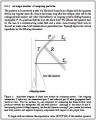
Introduction to Quantum Fields in Curved Spacetime and the Hawking Effect
by Ted Jacobson
Publisher: arXiv 2004
Number of pages: 59
Description:
These notes introduce the subject of quantum field theory in curved spacetime and some of its applications and the questions they raise. Topics include particle creation in time-dependent metrics, quantum origin of primordial perturbations, Hawking effect, the trans-Planckian question, and Hawking radiation on a lattice.
Download or read it online for free here:
Download link
(670KB, PDF)
Similar books
 Lectures on Tensor Categories and Modular Functors
by Bojko Bakalov, Alexander Kirillov - American Mathematical Society
The book gives an exposition of the relations among the following three topics: monoidal tensor categories (such as a category of representations of a quantum group), 3-dimensional topological quantum field theory, and 2-dimensional modular functors.
(10627 views)
 A Guide to Quantum Field Theory
by Kasper Peeters - Durham University
The course will introduce Quantum Field Theory (QFT) by bringing together concepts from classical Lagrangian and Hamiltonian mechanics, quantum mechanics and special relativity. We will also introduce string theory as a simple two-dimensional QFT.
(8324 views)
 Effective Action Approach to Quantum Field Theory
by Ivan G. Avramidi - New Mexico Institute of Mining and Technology
From the table of contents: Classical Field Theory (Models in field theory, Cauchy problem for Jacobi fields, Feynman propagator, Classical perturbation theory ...); Quantization of non-gauge field theories; Quantization of gauge field theories.
(11436 views)
 Introduction to Feynman Integrals
by Stefan Weinzierl - arXiv
An introduction to Feynman integrals. In the first part of the course the author reviews the basics of the perturbative expansion in quantum field theories. In the second part of the course he will discuss more advanced topics.
(10442 views)